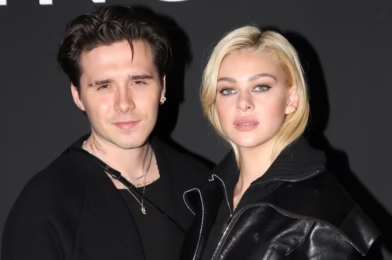
I am a middle aged woman of no consequence. Regardless, your story has invaded all of my social media feeds and as a result, you have become a person of consequence to me. As such, I would like to respond to your recent post about your Beckham-family misalignments. I think at least the Western World has put our fear of Trump’s next impulsive power grab on pause and collectively stopped to ogle. Way to break the chaos! Yet interestingly enough, even though your experience is conveying a bit weird and un-relatable, it is universal in its relatable-ness.
“Oh Brooklyn, Brooklyn, take me (us) in Are you aware the shape I’m (we’re) in? My Our hands, they shake, my our head, it spins Oh Brooklyn, Brooklyn, take me us in.”
In all sincerity, I’m sorry you’re struggling. Your feelings are valid from every vantage point. You’re not alone. Family stuff is hard. Most of us do not hail from the top .001% like you, nor do we live our lives as publicly as you and your family have done. Unlike you, when we have big feelings, if we do post online, you can be certain that unlike the response to you, a million people will not care to take our side while a million other people to hate us. I mean, look, as I mentioned, I am a complete unknown and you are the son of David Beckham and Posh Spice.
Let’s get to the meat:
I say this next part gently and with compassion: The way you publicly articulate your problems, stating things like, “the performative social media posts,” and, “I do not want to reconcile with my family,” make you appear performative, spoiled, entitled and tone deaf, exactly like the people you are addressing in your, “I am standing up for myself for the first time in my life,” post.
Brooklyn: (may I call you Brooklyn?) You are not like us. My hope is that you want to be more like us. I really hope you didn’t intend to come across as an out of touch, rich, spoiled, white boy. And because this is what I understand to be a parasocial interaction, (me to you), I recognize I will never know if you’ve connected the dots, yet I feel entitled to weigh in nevertheless.
What I have observed is that you’ve lived in a fortunate bubble echo chamber, a magic land where you have the funds to create a hot sauce brand on a whim. (I want the funds to create a hot sauce brand on a whim.) Sure, you were required to show up for family photo ops and yes, I am sure a bunch of it was a facade. Hey look, even while scream fighting with my dad, my mom was always able to stop and answer the phone in a friendly voice.
Truthfully, for like five minutes, your beef was a delightful distraction from our sad, heartbreaking world.
What would it be like if our only worries revolved around an annoying mother-in-law and having to replace a promise of an expensive custom wedding dress with another fabulous custom wedding dress? My wedding dress was altered incorrectly and the sleeves were too tight. I could not lift my arms and was forced to hold my arms at my side the entire day. My mom was missing-in-action and I didn’t have the funds or the know-how to make it right.
Stay with me.
Contrast your wife Nicola’s wedding dress & your wedding dance drama with the millions of people who are losing healthcare and the ones fearing for their safety.
Yes, we all agree: your family seems to live by the steely, cutthroat veneer your words so aptly reflect. Ultimately, you chose to air your grievances publicly, and I’m sure life with your mom is complicated at best. I have sons. I get it. I want to respect and care for the women they love. Sometimes that space is hard to navigate and I fully screw up.
I’m not asking you to show your mom grace. Maybe offer her a sandwich.
Like I said, and for like the billionth time, you don’t know me and I don’t know you. What I am conveying is gratitude for my sons who show me grace and care. Here is a thought? No matter what happens with your family, I hope you continue the healing process. I want to believe your post was you trying to break your dysfunctional family cycle. Am I right? Is that what you were trying to do? Some would argue that breaking cycles is simply growing up. I, myself, like the idea of breaking cycles.
So if that is who you are, keep breaking cycles!
Maybe you could start by removing yourself from the public eye. Set private boundaries and trust in us lookie loos to see you as the person you want your family and future generations to know.
Spitballing some ideas: You could refocus your energy toward volunteerism, say working with women’s healthcare, or make it a constant priority to donate time and money to a food bank. Open a wedding dress shop that gives dresses away to disadvantaged and marginalized women. I promise if you do something more than telling us how much your family sucks that you will be able to break the pattern of your crappy rich entitled family. You’ve got this!
I spent my entire youth trying sincerely to adhere to all of the strictures and standards the Church of Jesus Christ of Latter Day Saints expected of young people, while growing up in the Church and eventually attending Brigham Young University. The pressures and expectations eventually overwhelmed me, and half way through BYU I let loose and allowed myself to break the rules, which involved drinking alcohol and engaging in premarital sexual activity. It didn’t happen all at once. I would break the rules and feel guilty and repent, then transgress again and repent again. Over many years, I eventually came to see the Church’s prohibitions on drinking and its purity standards with some nuance, and I allowed the guilt for my transgressions to fade. A few times, in my attempts at 20-year-old-college-student authenticity, I nonchalantly drank coffee. When I did, I was haunted with a heartbeat of thoughts. I knew with every fiber of my being that every sip was pushing me farther away from my eternal salvation. I am not kidding. I don’t understand it either. My fear of coffee’s wrath was deep and far reaching. Somehow, among all of my rebellious transgressions, coffee drinking stood alone. Maybe because the coffee prohibition is unique to Mormons, its violation is most especially policed by the community, an outright rebellious act, and therefore it prompted a feeling in me of the most foul betrayal.
Instead of coffee, I sourced my caffeine by drinking copious amounts of Diet Coke. I drank so much Diet Coke that I’ve developed an aspartame sensitivity and can no longer drink Diet Coke without getting a migraine. During this era, the LDS church also disallowed drinking caffeinated soda, but the taboo against Coke was never as strong as the one against coffee, and most people, even at BYU, turned a blind eye to a Diet Coke addiction. I needed a Diet Coke replacement at the same time I was drifting away from Mormonism. That is when I shifted to green tea.
I was not able to simply drink green tea, however. Though I no longer attended church, my moral compass remained synchronized with LDS doctrines. I worked out a rationale that because green and white tea are the non-oxidized (non-fermented) type of the tea leaf, (black tea being the oxidized type), that drinking green tea was not violating the Mormon Word of Wisdom, in the same way that Mormons can drink grape or apple juice, but not wine or cider. Even after I was completely inactive in the LDS Faith, I continued my green tea superstition, which conveys to me now that I wasn’t just freaked out about coffee. I was paranoid about the eternal consequences of drinking coffee or black tea.
Green tea felt safe and kept me one step into my faith, which out of a similar superstition, I was fearful about fully leaving. Deep down, I was daunted by the idea that if I completely abandoned my upbringing, something super bad would happen to me like a piano might fall out of a window just as I walked by – killing me – because I deserved it. Nevertheless, my tea habit was a bit of a nuisance. Because green tea is light on caffeine, I drank it throughout the day. Ask Dave or my kids. They were always good sports. When we traveled the world, a world with super easily accessible coffee shops, free coffee at car rental dealerships and hotel rooms with more free coffee and coffee pots, I would find a way to procure green tea or white tea. They would never complain and instead helped me locate my favorite teas like the now retired Clipper White Tea Vanilla. Sure, many hotels have tea in the room. It was typically decaf or black. I preferred my tea with almond milk and little packets of stevia. It is my experience that the odds are high that even if there is green tea in the room, most hotels won’t have what I need. I started packing tea and stevia in my carryon. Everyone knew I drank copious amounts. My favorite tea order: Starbucks Venti Green Tea Unsweetened Light Ice.
Then two years ago I found myself on the brink of death. (I am not exaggerating.) I had been terribly ill for several months, including an continuous, choking cough that prevented me from speaking and that sometimes left me on all fours unable to take in a breath, severe chills, night sweats that soaked me head to toe several times during the night, sudden weight loss, fingernails peeling off, pallor, chronic tachycardia (my Apple Watch noticed my tachycardia and saved me twice by warning me to go to the hospital immediately). I spent months in home isolation, filling my days checking in with my doctors, seeing specialists, having endless blood tests and while I was surviving alone on my couch, watching the reality tv show “Alone,” about people surviving alone in the woods.
On a cold, late autumn afternoon I found myself at my allergy appointment when my internal medicine doctor called:
“It’s serious. Your bloodwork is bad. I’m not sure you’ll be ok. Your blood isn’t oxygenating well. You’ve gone off a cliff so to speak. I want to have you admitted to the hospital immediately. Can you go there now?”
Dave and I made our way over to the University of Utah Hospital where they were waiting, and spent several days having every imaginable test done, while being carefully monitored. A big part of what they were doing was systematically eliminating every type of cancer and acute illness, starting with the deadliest ones. One by one, we ruled out the various instant death sentences and horrible terminal diseases and eventually I was diagnosed with Anemia of Chronic Disease. Essentially, my bone marrow wasn’t functioning and all my intense symptoms were a result of my system’s inability to oxygenate my blood. My body couldn’t process iron in my diet or with oral supplements. I learned I would need iron infusions for the rest of my life. I received my first infusion in the hospital and for the next year, I had my blood tested every four weeks, and received fifteen additional iron infusions.
During that time I became aware that, besides having a few autoimmune issues, another thing that could be blunting my iron absorption was caffeine. See, I sipped my cups of green tea all day long, including at meals when I was receiving nutrients. As I became more run down, I craved a caffeine boost even more, and that created a vicious cycle. In my vulnerable state, my body wasn’t able to do what it was supposed to. I wasn’t getting iron. I was tired of being tired, and tired of feeling and thinking like I was going to die. I did constant research trying to figure out what I could do to get my body to work. Then in the Summer of 2024, I read that it’s easier for people with chronic anemia to absorb iron if they get their caffeine in one big dose at least an hour before or after meals, (as to not inhibit absorption). Honestly, I was probably drinking so much caffeine (like all my life) because I had undiagnosed celiac disease and as a result was already not properly absorbing nutrients.
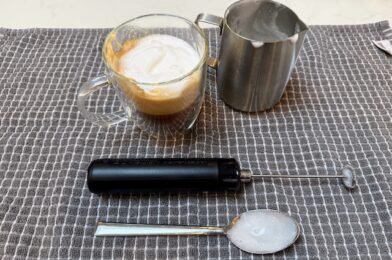
That is when a miracle happened. I thought to myself, “What if I drink coffee?” I started low stakes and bought a can of Starbucks Medium Roast instant coffee. I heated up a cup of hot water, used a ½ teaspoon to measure my servings. I already had become accustomed to frothing almond milk for my tea. I made the switch. I began spending an hour or two in the late morning each day sitting at the northeast corner of our kitchen island, drinking two cups of coffee. Coffee became my church. I frothed. I read. I wrote. I sipped.
Because I fear their Mormon judgement, I intentionally withheld my new “church service” from my family, especially my mom. My coffee time became sacred. It was my new religion. I shared how much the switch to coffee helped. Dave quickly picked up on this new space. I didn’t excuse it. I owned it. Occasionally he would forget, walk into the kitchen, see my sipping or frothing and say,
“Oh wait. Is it coffee time? I can wait.”
I loved him for respecting my boundary.
Soon, I started feeling well. I don’t want to make a spurious correlation and suggest that coffee is what moved me to better health. Then again, maybe it was the space I gave myself to have coffee and to feel good about myself. On Christmas 2024 Dave gave me a Moccamaster, a fancy pour-over coffee brewer from The Netherlands that looks like a chemistry set. He had purchased it at an auction—it had been returned because it had some chopped paint. (I think he paid $23.00.)
“Don’t worry. If you don’t like it. It’s no big deal. We can give it away.” He said.
Thanks in part to the lack of fanfare and pressure, I purchased a coffee grinder and embraced the ritual of grinding the beans and working the Moccamaster, and it became a keystone of Coffee Time.
Shortly after that Christmas, I was on Facetime with my LDS sister when Dave eagerly announced,
“Beth is using her new coffee machine.”
My shoulders tightened. I couldn’t force my sister to unsee our coffee machine. I felt the shame of someone who had committed a major sin. I felt an urge to confess – to her. I started rationalizing and explaining why I needed to drink coffee. I hung up the phone, my face red with shame. That is when I decided I didn’t need anyone’s moral approval or permission to drink coffee. I never looked back.
We found the right cone-shaped coffee filters at Costco and I fully transitioned from instant coffee and learned to brew an excellent pot of coffee. A local roaster, La Barba Coffee, is my favorite. I love their House and Anchor varieties. I’ve gone through several frothers and am glad we purchased the extended warranty on the Kuerig Brand frother. (I’m currently on my third Kuerig frother.) I’ve taken our backup frothers all over the world, including to Chile where we hiked the W Trek in Torres Del Paine.
Last week I opened my 2025 Christmas present: a Breville Bambino Plus Espresso Machine. It’s cute and shiny! Kyle, my oldest, gave me a coffee subscription and two coffee mugs, one is a double walled glass mug and the other a personalized Prospect Lefferts mug & Brooklyn Botanical Garden coaster from the NYC nieghborhood he lives in. The learning curve wasn’t as steep as I thought it would be. I learned why we tamp, how to tamp, and even bought myself a tamping station. By the end of the week I was making the perfect-for-me Americano. We spent the entire holiday talking, connecting and making coffee drinks.
The other day, Kyle had been visiting for Christmas and participated in the espresso festivities, said he already missed my espresso maker. I sent him a picture, which he promptly “hearted.” As I reflect, I don’t understand why I let coffee or the idea of drinking coffee terrify me and allow it to be some sort of measure of my worthiness. I wish it wouldn’t have taken me almost dying to internalize that drinking coffee wouldn’t cause my eternal damnation. I respect that people have their own relationship with coffee, tea, or “strong drinks.” I grieve the years I didn’t drink coffee and am relieved that I finally feel safe drinking coffee on a regular basis. Maybe some day I’ll be brave enough not to hide my habit from my Mormon family. Ultimately, my body loves coffee. I feel healed. I love my new church. I love my coffee and I still drink tea — all the flavors.
For like twenty years, on and off, I have been working on my memoir. Really. Stops and starts. That is what it has been. I test the waters. When I do write about a family member, or suggest to family that I might be writing my story, I am often met with pushback and threats. I shut up. Like I am trapped in a sinking car, I want to breathe so I stop writing. As I surface, I realize that my words want to come out. Honestly, I wish my family understood that this is my story, yet I don’t expect them to. I don’t want to share their secrets or make my story them about them. Instead, I offer them grace. I take deep breaths. I go to therapy. I write privately. When I do freak out or worry about being sued, (yes, I have been threatened), I think of the words of writer Anne Lamott:
We write to expose the unexposed. If there is one door in the castle you have been told not to go through, you must (open the door)…You can’t do this without discovering your own true voice, and you can’t find your true voice and peer behind the door and report honestly and clearly to us if your parents (or siblings) are reading over your shoulder. They are probably the ones who told you not to open that door in the first place. You can tell if they’re there because a small voice will say, ‘Oh, whoops, don’t say that, that’s a secret,’ or ‘That’s a bad word,’ [Instead]…Write as if your parents (and siblings) are dead.
I have lived another entire lifetime since I first had a story I wanted to tell. I married. We had two beautiful sons. My heartaches like infertility, suffocating loss, and serious health crises have (hopefully) filled me with compassion and the ability to confidently and lovingly share my truth. I have taken that time to learn how to set boundaries and break cycles. I am a work in progress. I know my past lurks in the shadows, and like cocaine in the 1980’s, it begs me to repeat its dysregulated patterns.
In 2020, out of things to sanitize and masks to buy, I started getting serious about my life story. We (like the world) were stuck at home. In our case, our eldest son was ripped from his dreamy Sydney, Australia Study Abroad. His girlfriend, who was studying away in Paris, was also forced to leave. She moved in. A month later, our youngest graduated from high school in an eleven minute drive-through ceremony at a local park, including a picture with his principal and returning his cap and gown correctly on the hanger on the rack situated on the park lawn.
We were (still) trapped at home. As the parent, (whatever that means), I tried not to make things worse. Our house was really clean, especially our kitchen counters, which I repeatedly washed out of sheer boredom and maybe germs. Our pandemic-addition was nearly complete, which included expanding our master bedroom and the one below. Out of counter spray and maybe a little loneliness, one morning I began digging through our storage. I happened upon my old journals. I picked one up and began to read from February 11: “Today is Dad’s fiftieth birthday. Two weeks ago he told Mom he doesn’t know if there is a God.” I read on and was hooked. A few pages later—April of that year—I wrote, “Well, Mom and Dad are really getting a divorce.”
That night I told my husband about hours I spent reading. Enthusiastically he urged: “These are primary source materials. Use them in your memoir!” It had never occurred to me that I could use the assistance of my childhood journals to tell my own stories. I said right out loud: “Dude, you are a genius!” I decided to see how I could infuse my journals into my story.
Of course. See, it was my mom who taught me about journals. After spending the day reading and reflecting, I wondered if Mom used her journals to record the bad feelings and fear of God, the obvious echoes of her own trauma. Nevertheless, in the corner of our dusty storage room it was clear that Mom’s own trauma and journal-keeping were ingredients in what I would call my epic narrative; a crucial ingredient like flour or eggs.
As I read, in a flash of big “I am being followed down a dark alley” feelings, memories of my past flooded in. I felt the dread of Mom’s constant, “I have a bad feeling. Did you pray?” I continued reading as my ominous feelings were validated: “Mom” literally had a “bad feeling.” I thought about my mom. I wondered if her need to feel safe and in control were constant, and were easily reflected in her daily rituals and routines, like writing in her journal, reading her scriptures each night and kneeling in prayer.
I recalled seeing her, scriptures open, reading and highlighting.
She would explain, “The Mormon prophet and leader of our church proclaimed that for us to receive Heavenly Father’s blessings we need to read the scriptures for at least thirty minutes a day.”
Once she finished her thirty minutes, she meticulously brushed her teeth, made her way into her room, knelt at her bedside and said her prayers. “The prophet has also asked us to pray for thirty minutes each night. I can’t let him down.” I often found her asleep, still kneeling at her bedside.
The part of her routine I was most intrigued with was her commitment to journaling. Journaling wasn’t just a novelty, quirk or affectation. It was my mother’s adherence to a specific admonition from our church leaders. Before her scriptures and prayers, Mom, dressed in a flannel nightgown, found her way to a quiet corner, which usually was our upstairs yellow and brown-colored, plaid couch. Holding a ballpoint pen in her left hand, (I am also left handed), I watched as she began writing words in a large notebook:
“Mommy, why are you writing in that book?” I asked.
“I don’t always remember everything. I want to keep a record of our life. Our prophet has asked us to keep a journal. I want to follow the teachings of our Heavenly Father.”
I felt Mom’s urgency to follow God’s commandments. Consequently, when I was seven years old I asked Mom for my own journal.
“Oh Bethy, Heavenly Father will be so proud of you.”
Then one day she handed me a journal. I hoped God would take note. Writing came naturally. So did processing the world around me.
In what some might call “exhausting detail,” I logged my daily life. When I did not log my life, I felt like I was letting God down.
Picture a piece of lined notebook paper. There are two to four words per line with twice as much space in between each word. The page is positioned in a 1.5” mustard yellow spiral ring binder, next to a cardstock cover of a bible coloring book called, “The Life of Daniel,” (You know, Daniel, the guy in the Bible saved by God as he sat in the Lion’s den.)
My first journal entry:
“This is the story of my life. When I was four I moved in a new house. It was fun but sometimes I was sad…”
Out of some obligation to God, or probably because I really enjoyed it, I never stopped journaling. I wrote what I saw or wanted to know, which led me here to sharing my story. As I did research for this memoir, I followed through and reviewed thousands of pages from my hand-written diaries, from that very first journal entry to the laptop I write in today. Through the years, my life’s experiences have been edited, mellowed and recontextualized into the memories that live in my head. As I read my writing, my own primary sources, including pages that I may not have read since the moment I wrote them, I have come to learn that my actual memories are much softer than the words I found hidden on those pages. Not only had I forgotten many painful, horrible events, the experiences I did remember have been worn smooth, illuminated with compassionate light.
As I read my childhood journals with a grown up understanding, I am amazed at all the buried, dark family secrets and revelations that have emerged. Truths were waiting in plain sight, if not always in plain language. I wrote around the brokenness. I left out the specific details, like how loud I screamed or how many times I cried myself to sleep or woke myself up in a cold sweat.
In my case, my writing became less about fulfilling an obligation and more about me. What I observed, which I am still trying to reckon with, is that I wrote about my traumas so casually that it was as if expressing them were as normal as blowing your nose—as mundane as watching television with an old remote control. I wonder if me of yesterday hoped that me of today would be able to decode those empty, clearly identifiable spaces shaped exactly like each specific trauma. I am here to say, “I think so.”
This became my writing practice: I watched. I observed. I processed it. I could not stop taking it all in. I loved taking it all in. I analyzed and deconstructed everyone and everything as a means to understand the world around me. I talked about what I saw: “Mom, did you see the man on the street? He was wearing a brown shirt and green striped pants. He wasn’t wearing shoes. I wonder if he is cold.” Mom was a great listener. After I exhausted my voice, and probably my mom’s ears, I wrote everything down.
My journaling is vivid. I am curious. I am interested. I love human behavior. I love how people interact. I absolutely love human connection. As such, I receive the world through the lens of relationships. Asking my mom and dad about sex at the dinner table as a nine-year-old completely made sense and had no bearing on the fact that my two older brothers and three older sisters were sitting around that table with me. I would also argue that there is a human need to construct and reconstruct which gives voice to our story, authority and ultimately healing to our lives. Ultimately, with all my observations and questions answered and then recorded in my journal, my journals have become the reliable narrator in my story.
I am grateful for Mom’s desire to journal all those years ago and my desire to follow suit. Without those decades of record keeping, I don’t think that I would have a good understanding of the events that shaped me and set me on my course, and I would not be able to understand my own mind, my personality, or my family dynamic as well today.
By the way, I certainly do not claim to be the world’s best writer, observer, human, wife, mother, sister, daughter or friend. I am a storyteller. We are human. I am human. I believe that we are here to heal, to forgive and to learn. This is my hope.
[Trigger Warning: authority abuse, brief mention of sexual abuse]
I specifically chose not to include the more profound abuse I have experienced. Unfortunately the experiences I included here are quietly commonplace. When I am all alone and safe, the phrase I think of are “culturally insidious, misuse of power and epidemic abuses.” In fact, I think the small acts of petty domination, verbal threatening, and entitled abuses of power have become (almost) ordinary. As a society we are not just guilty of re-victimizing women who have suffered horrific sexual assault. We are guilty of letting casual dominance slide until it is commonplace. My guess is most men who commit sexual misconduct do not start off by raping women. In fact, I would argue that sexual assault may actually be an outgrowth of entitled people throwing their weight around and misusing their power.
…There I was. In a Brigham Young University classroom.
After the professor asked for feedback and promised he was open to whatever we had to say, I spoke up. Class finished. Two classmates and I stood in the hallway talking. My professor walked up. I asked him a question about my upcoming paper. Instead of answering, he asked me to follow him onto the elevator — alone. Obediently I followed. The doors shut. We stood in silence. Several long seconds later, we arrived on his floor. He stepped out and I followed him into his office. He shut the door behind me. I sat down across from him. Before I could ask my question, he interrupted. Assuming he forgot why we were there, I gave him the benefit when he began berating me for speaking up in class. Nevertheless, I was blindsided. He told me it was not my place to give feedback and that I should know better than to challenge him. Several times he admonished making claims such as, “Beth, your words are unacceptable. Do not embarrass me in public again.” On and on he went until his words blurred into one powerful message:
“Beth, you are bad. I am good. Do not challenge my power!”
With my sense of right and wrong knocked off its axis, tears screamed down my face. I needed this to end. Defending myself only incited him further. I was breathless, frustrated and needed him to stop telling me how bad I was. I needed to get out of the room. Instead of realizing I could just get up and leave, I found myself apologizing. My apologies only made things worse. I was trapped. He was angry. I don’t know if it was my wet face or my silence. Eventually he finished. I left. We never talked about my assignment. A month or so later, I sent him an apology.
…Years earlier I was working on the very same Brigham Young University campus at a job I loved. My boss at the time was giving a tour to some outside visitors. I had no idea I was in his way. Regardless, he forcefully grabbed me by the upper arm and held it tight. Then he abruptly yanked me from where I was standing. As I stood there stunned, he looked back and admonished:
“Next, time you are in my way. I need you to move.”
I knew what he did was not right, but I had no idea what he did was criminal battery. I did nothing. Later that semester I withdrew from some of my classes. The secretary at the time asked me to fill in for her for a few hours when her father-in-law passed away. Of course I said yes. A week or so later that same boss sat me down in his office. He asked me not to speak. Here is what he said,
“Beth, by working for the secretary you were deceitful and are unworthy. I could fire you. Instead, I will ask you not to return next semester.”
I make no excuses, yet had no idea that I could not work if I was not a full time student.
…Around the same time, I was dating someone I thought I would marry. Even though we were not having sex, we crossed a lot of lines. According to Brigham Young University professor Brian Willoghby, the Church of Jesus Christ of Latter-Day Saints’ stance on premarital sex is the following:
“Although the church discourages ‘any kind of sexual behavior’ before marriage, sex is considered a ‘bonding experience’ once the couple has entered a committed union.”
As a practicing Mormon (at the time), I understandably felt guilty, so I did what LDS members are encouraged to do: I went to my ecclesiastical leader to confess. My Mormon bishop said it would not be easy and that he may excommunicate me. He asked me to make a chart of my repentance progress and then to show him my chart progress during our weekly visits. He said my forgiveness was contingent on how I filled out my chart. He also said that under no uncertain terms that my forgiveness was also contingent on me NOT SEEING my boyfriend, (which he asked me to keep track of on my progress chart). That bishop and I met for several months. One week I was five minutes late for my appointment. He stated, and I quote,
“Because you are late, you are showing God that you do not want to be forgiven. Do you even want to repent? I need to know! I need to know now!” I assured him that I did want to repent. He paused for what seemed like forever. He continued, “Beth, I am not sure. I will have to think about your behavior today. Honestly, I can see you are not taking your repentance process seriously. You may need to be disfellowshipped. When I figure it out, I will let you know what I decide.”
(In Mormonism, “disfellowship” means a disciplinary action less severe than excommunication.) We continued our visits for a few months. I was terrified and began to think I was evil.
After my boyfriend and I broke up I was casually dating a few people. One of them was very well liked member of the Provo, Utah community. One day I stopped by his work to say hello. He said,
“Beth, sit here. I will be right back.”
I was a little confused when he asked the few remaining customers to leave. Then he locked the door. I tried to leave. He insisted I remain where I was sitting. He walked up to the table and sat across from me. As the abuse started, a sort of twisted negotiation began. If I let him do what he wanted to do and told him it I liked it, then he would let me leave. I was frozen, afraid to move. This man is much bigger than I am. I am not comfortable saying what happened next. At the time, I also did not want to upset the community by getting this very well liked individual in trouble. Consequently, I did not go to the police. Instead, I told a couple of our mutual friends. One of those friends told some of this man’s co-workers. Instead of offering me help, validation, or just staying out of it, these co-workers told me I was no longer welcome at their place of business, and if they saw me, they would ask me to leave.
Upon reflection, I can say I noticed red flags in all of these situations. I asked for help and was often asked what I had done to mislead these men. I was also told that I should let it go or just go along with it. As a result, I kept my head down and thought if I were a better person, these things would not happen. After many years and many experiences, it finally hit me: I did not cause the abuse or cause someone to misuse their authority. It was not my fault. Nevertheless, I remained silent.
Regarding the news of: this moments sexual abuse issue, why did it take so much effort to bring awareness, and ultimately action, to the situation? Is it because of silence? Or is it that popular, powerful or even patriarchal people get a pass? Are we the enablers? Is that why pleas for help fall on deaf ears? Because of the sorrow my own silence has caused, I would suggest that our collective conversation can help break these culturally baked-in patterns.
And yes, what the news of [insert latest Sexual Abuse issue here] has done this week is (again) open a dialog. And now we have an opportunity to be different. We can chose to stop reacting off of sound bytes and social media outbursts. In contrast, I think we need talk and keep talking. We need all the voices. (I also recognize that getting people to listen is not always easy.) As I mentioned, I have tried a thousand different ways to begin this conversation myself. Something always stops me. Usually that something is my fear of embarrassing those closest to me. Ultimately, I stop talking, slow down my own healing, and pretend that everything is ok. Usually I realize that my need not to embarrass those I love only serves to enable the abuser. Then something like [insert current Sexual Abuse issue here], wakes me up and I ask myself,
“Why did it take so long for people to speak up?”
Obviously I have already internalized the answer: Embarrassment, shame, fear, or complacency. All of these things kept me silent. I also know that my silence perpetuates the abuse cycle.
I have a lot of rationalizations. I live in a culture where a man is the man and for me to scream is a sign of disrespect, which again enables the cycle: silence. And to fight the silence, I know I need to keep talking, but then the fear of upsetting my loved ones takes over. Even though I know that talking will protect us and that our conversations will teach us balance and discernment. Why I am speaking up now is that I recognize that words are also power. Our conversations will only serve to help us teach our children that they deserve respect; that our daughters do not have to compromise their integrity; and that our sons must be good men, even when society is telling men that they have a role: predator, (a.k.a. teenage boy who wants to touch a teenage girl’s boobs).
I also recognize that patterns are hard to break. I am a wife, a mother, a daughter and a sister. I want to be better. I want to do better. I think we all do. I want my boys to be transparent. I want to model boundaries and I want my boys to have boundaries. And that is why we dialog. I drill consent and talk about the things that are uncomfortable. I think it is also fair to mention that parenting alongside other parents can be muddy. We have dealt with other parents and their reactions to my sons, like the dad who asserted,
“I know how teenage boys think. I was one.”
As a mother, I wanted to disagree (because I do) and scream,
“Why can’t we do better?”
I remained silent. And really I am not always sure how, but I think we can do better. My initial step was to get comfortable with me (not easy still) and next to have a healthy relationship (with a man). And that is why I cannonballed myself into the deep end and dated a lot top notch guys [insert heavy sarcasm here]. First, there was the guy from church who told me I would never get married if I didn’t marry him (I was 19). At some point there was the “upstanding guy” who wanted me to reimburse his expenses after the date because I would not have sex with him; the dude who took his clothes off while I was not looking and insisted on walking to the car naked (even after I insisted he put his clothes back on); oh and the guy who said,
“Beth, you would be so much more comfortable if you took your pants off.”
Then there was the guy who dated me while engaged (he lied to both of us), the guy who liked to come to the door in a towel. As soon as I walked into his apartment, his towel would drop to the floor, and the guy I had a huge crush on. When we finally were alone. He asked me to give him a hand job, but not kiss him. He told me.
“I just broke up with my girlfriend. Kissing you is too intimate and makes me think of her.”
At least he eventually apologized — I guess [insert me shrugging my shoulders]. Finally, there was the seemingly gentle guy who in a firm voice said there was something wrong with me because I did not like Disney movies. What? (He also freaked out and berated me when I tried to end our relationship).
“You will not find anyone better than me.” he insisted.
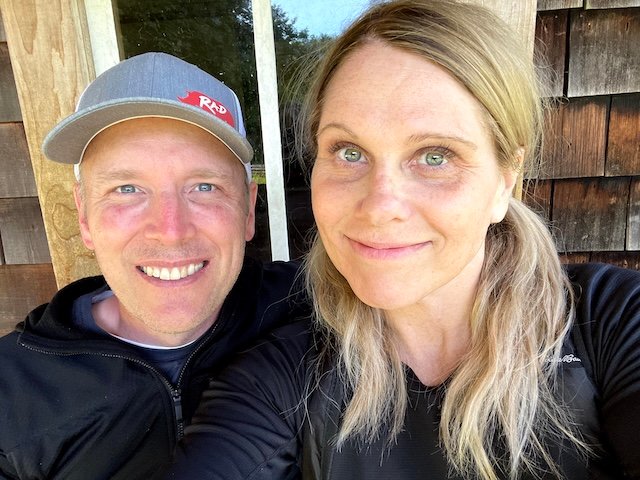
Dave and I in Castres, France
Thank goodness he was wrong and double thank goodness for Dave. I chose him specifically because he was different than the others. He had boundaries and he respected mine. And here is the good nudge: I chose. I did not sell myself or settle (even though I was encouraged to settle every single day). Instead, I literally decided that I was tired of dating men who treated me poorly. And seriously, by the time Dave and I found one another, most people thought I was not worth someone like Dave (and told me as much). I found my worth from within. And that is what I want to say out loud:
“Learn from me. You get to chose who you love. You deserve a healthy relationship. You get to hold your boundaries. You are not bad if you say no.”
Society does not make self worth easy either. Ultimately, I told myself that I was worthy of a healthy relationship. And maybe that is a first. Consequently, I deliberately turned a corner and there he was. It was not magic. It was so fucking hard. I reminded myself that I was not Dave’s property. Our relationship was not solely based on our sexual connection or manipulation. I did not have to entice him sexually to get him to like me, nor did he ever coerce me to do anything I did not want to do. He did not humiliate me. He respected my boundaries. He liked me, and was delightfully amused that I did not want to watch “The Little Mermaid,” or any Disney animated film, for that matter. Dave talked to me. He held my hand, and he was honest (even when he wanted to break up with me — like all the time).
Even though our marriage can help stop the cycle of abuse, Dave cannot heal my pain or break the patterns, and sometimes he even crosses them. (He is learning.) He also supports me speaking up and healing. As a parent, he does not want to perpetuate unhealthy societal patterns either. That is why he wants his sons to treat others with the respect he treats me with. Again, learn from me, even though you speak up, the pain may remain close and awkward. It is ok. Mine does. I think it always will. Maybe I can use my pain to effect change in a culture that patterns abuse. That is what I am (trying) to do now.
And what happens when we take our conversation beyond this moment? Answer: a lot
Such as, what if your abuser is a relative, a close friend, an ecclesiastical leader, a professor, or your boss? What if the abuser is someone in a position of power or authority? What if he or she is someone you have been taught to respect or revere? What about people who are wrongly accused of abuse? Does that happen? What about the under-reactions, over-reactions, misdirections and inappropriate responses? I know how people freak out over minor issues and how others will take the secret of being raped to their death. I also know that people who actually have been abused do not trust they will be heard. How do we make it stop?
I do not have a perfect answer. Nevertheless, and from whatever lens you are viewing my words, I think the conversation is key to healing. So maybe the answer is to keep it simple. Trust that we will figure it out. Know that you are not alone. Just keep opening your mouth and using your voice. The more we use it, the easier it will become.
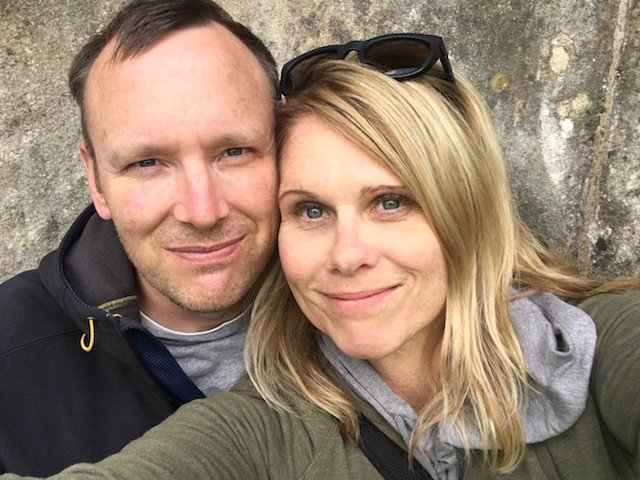
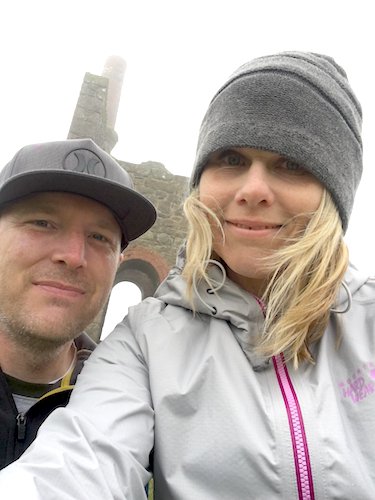
Hands down, Dave is a my Best Friend. Here we are at Dyrham Park National Trust Site, Gloucestershire, England
Please do not take it personally. First, and foremost, I LOVE people and my relationships with them. Through years of practice, I have also learned that friendship is not an exact science. Thankfully, I have awesome friends; friends who are cool with who I am (or are super awesome at pretending). And because I am a huge sucker for connection, especially the connection that the word “friendship” or “best friend” implies, I take my role as friend very seriously (like in a for-real blood oath kind of way). I sincerely believe (again, in like in a freakish, overachiever sort of way) that love, loyalty, honesty, transparency, responsibility, integrity and follow-through are friendship’s core values. And like some sort of super-earnest, albeit a little sarcastic, Joan-of-Arc (or just like a very devoted pet) I completely commit to my friends. And in the interest of full disclosure, I also commit to those who insist I am their friend, even those who literally have no clue how to be a friend, like those “friends” who are only “friendly” when they need a favor. And of course I have also found myself sucked into the blackhole of friendship with the occasional narcissist, stridently co-dependent, gaslight-er, sociopath and life-bloodsucker.
Hey and most relationship are cool and balanced, right? It does not take much for me to heed the charge or enable an imbalanced connection. Whereas, when the plane is going down and I should be putting my oxygen mask on first, all you have to do is show me your tangled cord and in the name of “friendship,” I will suffocate. If it means you can breathe, I will lose consciousness. All the while ignoring the fact that had I actually put my mask on first we both would be breathing. My dysfunction is on me. And believe me, the dysfunction goes deep and is probably baked right into my DNA. I love the rush of helping others — sometimes even conflating help (being used) with true and connection friendship. I get it. Feeling needed feels good. Feeling needed, or better, helping is a great avoidance technique.
I really like my kids. And yes, I will go against so conventions and say that I am so glad they are my friends. This is Kyle & I at Levant Mine and Beam Engine National Trust Site, Trewellard, Penzance, England
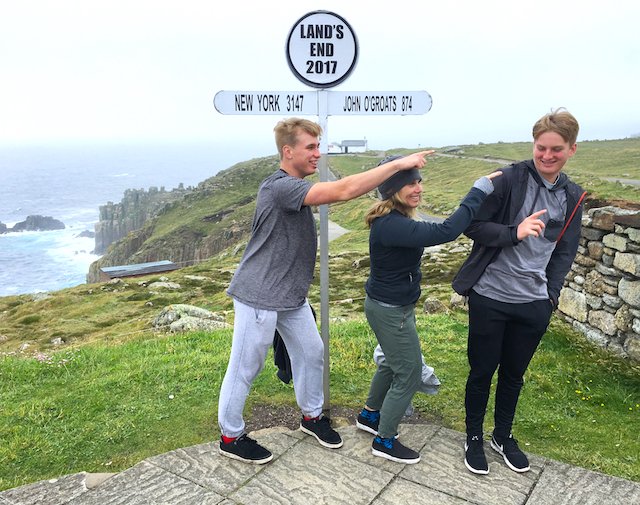
I love these boys! Land’s End, Cornwall, England
The other day I needed to put my oxygen mask on. I was trying to sleep. I should have been sleeping. I was very tired. My back hurt. I was exhausted and catching a cold. The night before I was up past 1AM and then up again at 6AM. I wanted to say goodbye to Kyle. He was leaving for his Varsity Cross Country team run. As luck would have it, Kyle left his cellphone on the kitchen counter. And so it began… Every nine minutes I heard the beep, beep, beep of his cell phone alarm. Because I could not figure out his password, the only thing I could do is hit snooze, which meant I was also up every nine minutes. It never occurred to me to bring his phone into my room, hide it outside, or guess the password (which I actually knew). I was supposed to go walking with my friend Rita shortly. Because I trusted she would kind and empathetic, I knew she would be cool if I canceled. She was. In her text filled with a bunch of heart emojis she said,
“No problem. Let’s go Friday.”
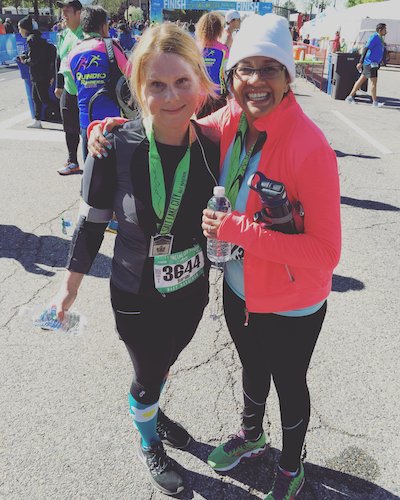
My friend, Rita & I after we finished the SLC Half Marathon. (It was epic.)
Feeling relieved, I went back to sleep. Within minutes I heard my phone beep. I was mad at myself for not putting my phone on “do not disturb.” I felt the obligation to look. Someone did need me. I felt compelled to “be a friend.” It was only going to be a few minutes, but those few minutes also meant I needed to get up, brush my teeth, brush my hair and locate what this person needed. It also meant that I was up. So, Instead of sleeping I said,
“Sure. Come on over.”
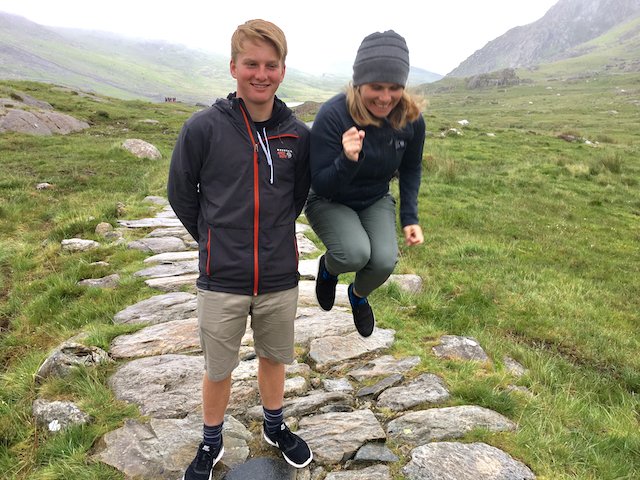
Me & Easy E. He puts up with me & is a super considerate human. Man, I love this kid! Snowdownia National Park, Wales
I do not think I am the only one who feels compelled to be a “good friend.” I do not think it is bad to help someone in need either. What I am truly suggesting is balance.
Culturally, I think women are taught to put everyone’s needs before their own, especially in the culture I was raised in. I think this baked-in, I-must-serve behavior complicates true, bonded friendship even further. Many people feel such an urge to please others, even their own friends, that they forget to take care of themselves, or to have boundaries, like I did that morning. Sure, our commitments and obligations are distracting. Time is short. Oh yes, and then there is the whole part about having our “me” time versus our guilt about being a good friend, or at least being seen as a good friend. What complicates the concept of friendship even more is that from my experience, we are all different. And because we are different, there is a no roadmap to perfect friendship.
My friends, Emily, Andi & I, Galilee Grill & Bakery, Lindon, Utah
Moe & I, Red Iguana, Salt Lake City, Utah
Because I have made many wrong turns, I hope I can help you avoid the detour by offering you a few directions. I will start with the idea that friendship is not a one-sided service project. Meaning, friends are not a box to check or a badge to earn, someone to possess or a crazy, co-dependent feedback loop. Friendship should definitely not be a status or hierarchical-based relationship. (You can save that relationship for your boss, as a super-fan, or when you move to North Korea.)
In contrast, I would suggest that friendship really is mutual affection. Meaning, we both get to equally dictate the terms of our relationship (high fives to that). Friendship is boundaries and support (even when either is uncomfortable). We do not have to text everyday, talk every week, or even see each other every year. And because we stand by each other’s side, when we are together, our friendship has integrity. We mean what we say. We apologize when we are wrong. We are honest, (even when truth adjusting would be way more comfortable). We are loyal (even when it is not cool). Mostly, we forgive.
It took me a long time to fully digest the concept that for me to be a good and committed friend I cannot possibly be friends with everyone. Ok. Wait. I will push back here to say that Facebook and Facebook friendship is not what I am referring too. So in the Facebook realm, yes, I believe you and Mark Zuckerberg can friend the entire world. In support of my friend-the-world claim, Dave often observes:
“You have a super liberal Facebook friend policy.”
“Yes. Yes I do. I love people.” I respond.
Me & Big Daddy at Levant Mine and Beam Engine, National Trust Site, Trewellard, Penzance, England
Alas, Dave is correct and also proves the fact that the people you acquaint with are not all friends. See, a few years ago, a high-profile-on-the-internet guy friended me. Obviously liberal-Facebook-friend-policy-me accepted his request, even though (once again), we had not met. Of course, like I suspect many people do, I checked out his Facebook page before I actually accepted his request. When I saw his friend total, the smart-ass in me was like,
“Seriously, you 4,999 personal friends? You mean to tell me you know every single one of these people — by name?” And because I am bubbling with dry sarcasm, I continued my internal discussion and said, “How do you have time for all of those relationships [long pause] and your family [even longer pause] especially your wife?”
Well, you don’t. For example, I saw this same dude recently at a Cross Country meet. I literally ran into him. By his long, perplexed stare, I assumed he thought he knew me. His wife looked similarly bewildered. Dave was half way across the race course, so alone, I said “Hello.”
He paused and stared at me for a really long time. That is when I impatiently thought (because I needed to find Kyle & Eli),
“Wait for it. Wait for it.”
“Hi Barb.” He said.
Ok. I am kidding. In truth he said, “Hi Beth,” as I began to lift my hand to give him a high five. Realizing he was not going to make the connection, I quickly & nervously brushed my hand into my hair as if I meant to do that.
Alas, even though he remembered my name, the uncomfortable moment would not end. As I answered, his wife, in sort of a stunned and freaked out way quickly asked,
“well, how do you know him?”
And that is when I gave her the name of one our mutual real-life friends. I know they are real friends because tagged pictures of them spending time together always roll through my Facebook feed. His wife seemed to relax, which was good.
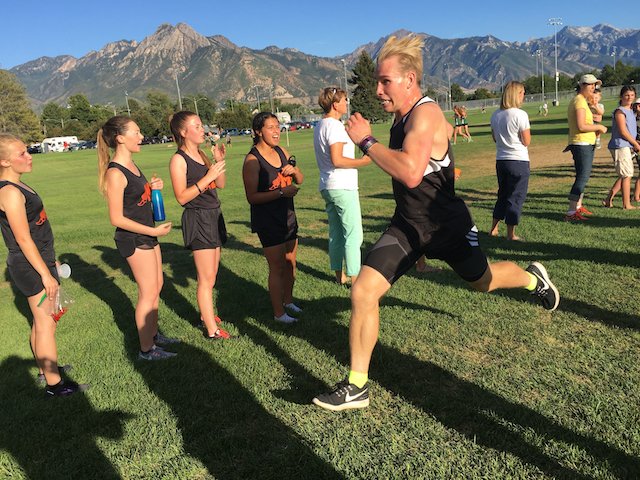
Easy E, Pre-Region Cross Country Meet, Cottonwood Complex, Salt Lake City, Utah
Kyle a t the Pre-Region Cross Country Meet, Cottonwood Complex, Salt Lake City, Utah
Here is the deal. This dude (bless his heart), despite having met me in person a dozen times since we became Facebook friends, never knows my name. When he stumbles with any sort of recognition, I wonder if he thinks I am a super-fan or a stalker. And because he is the one who friended me, his incongruous reaction always fascinates me. Obviously we are not friends. We are barely acquaintances.
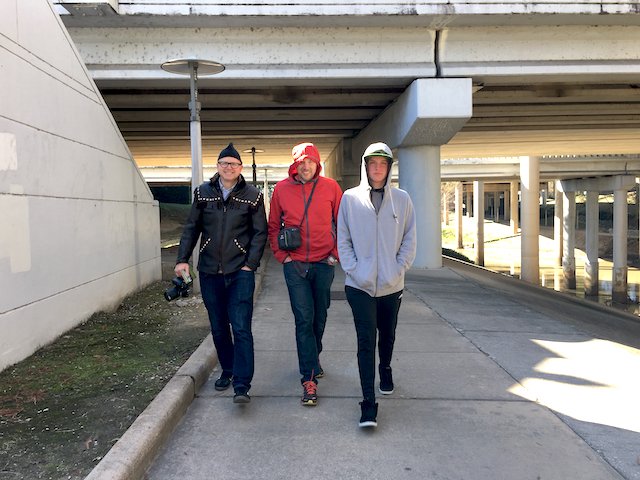
Doug, Dave & Easy E, Buffalo Bayou Walk, Houston, Texas, January, 2017
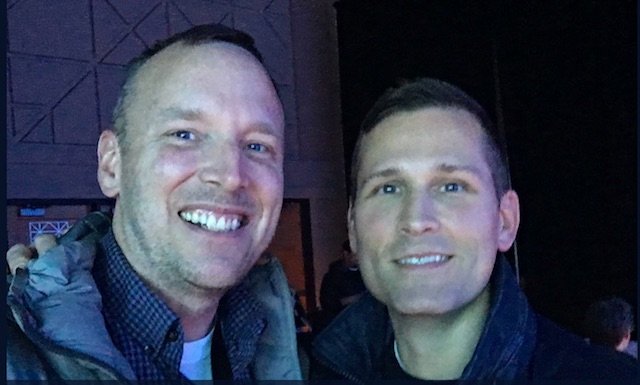
Dave & Ryan Raddon, SLC, Utah
His incongruous reaction, like many others, got me thinking. Has Facebook eviscerated the connection of real friendship? Do we know some people way more than we should? And is there any real-life correlation between Facebook friend totals, real world relationships and imbalanced obligation? I do not know. I think we all Facebook friend differently. Nevertheless, I do belive Facebook and social media are influencing how we friend. Just last week, because a woman who friended me seemed so cool and is a friend of a friend, I accepted her friend request. And guess what? She is cool. And yes, you read that correctly. I accepted the friend request of someone I have never met, or at least do not remember meeting. I know I am not the only one. And because she now owns the title of my friend, should I give her the same friend benefits? Am I obligated to wake up for her when I should be sleeping? I was friended by my friend Letti after knowing her for twenty minutes (and I really like her in real life). (Fun Fact: twenty minutes was the same amount of time I knew my friend Mike’s brother before making out with him.) Moving way beyond my fun fact, I also have friends who I have met once (in person), only to become really great friends via Facebook. Doug Vandiford, we are talking to you. On the other hand, Dave Facebook friends only those he really really knows. In contrast to my interaction, Dave actually knew Doug Vandiford way back when they were in the BYU dorms together (with Ryan Raddon (DJ Kaskade namedrop). And guess what? These three dudes are still real life friends. Ok. I would also argue that there are many sides to non-discriminatory Facebook friend requests (which have absolutely nothing to do with the concept of friendship I began with). That is why I would suggest is that bonded friendship goes well beyond today’s Facebook friendship friending rituals, and that the mutual affection of friendship actually takes effort. I would also suggest that having only a handful of friends is a very good thing. Considering the effort it takes to be a friend, I would like to offer that we may only have healthy space for a handful of friends. Meaning, that the other 4,988 relationships may fall into the category of acquaintance. (I think that is ok, by the way.)
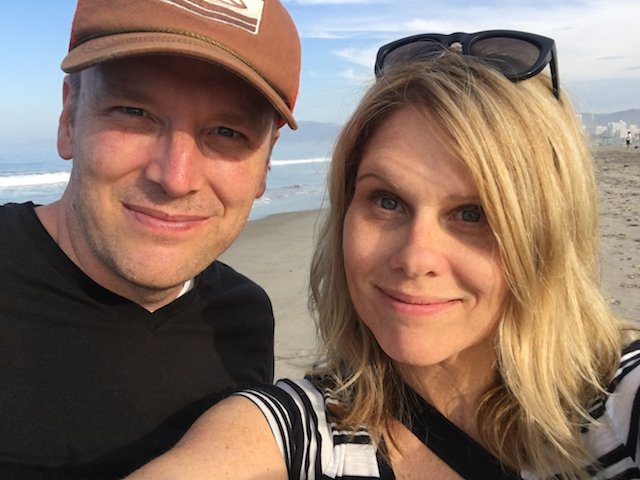
Me & Big Daddy, Venice Beach, California
Think of it this way. An acquaintance can be an ally without all the strings or obligations. I would also argue that if you put most people into the acquaintance category, your disappointment will decrease, your awkward moments at your boys’ cross country meet will not feel like rejection, and that your expectations of reciprocity may soften. And if you see relationships through the acquaintance lens I would argue that your relationships with these people may actually be healthier, more fun, and more fulfilling (or even an serendipitous networking opportunity). I would to think about it this way: An acquaintance is a friend without the loyalty and expectation. Do I care if an acquaintance blows off dinner plans? Do I care if an acquaintance makes up a lame ass excuse for not including me? Do I care if an acquaintance tells everyone I am high maintenance (dude, I have food allergies, get over it). Do I mind if an acquaintance tells everyone I have social anxiety, or that I am too religious, or that I am not religious enough? Nope. Do I care if an acquaintance needs a favor, even though I have not heard from them in years? No. I am happy to help — always (even when I would rather be sleeping).
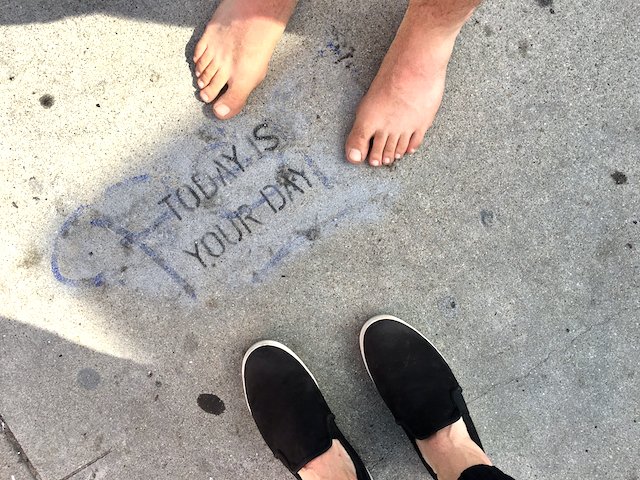
Our feet, Venice Beach, California
Bottom line: I say learn from me. Figure out how you want to friend, and then trust it — (as long as you are not being a tool and are being transparent).
Kyle, Bern-Gurten Park, Bern, Switzerland with the Alps in the background
I had no idea. Sure, I kind of knew I was depressed. I just thought it was my typical Seasonal Affected Disorder. Winter grey is no fun every single year. As a result of my malaise, I was not correlating that the darkness I was feeling was because of my eyes. And because I am pretty farsighted, I figured my bad eyesight was a result of my inability to read tiny ingredient labels. And for some reason I attached my tiny label issue to my utter inability to read larger font restaurant menus. I gave up and Dave always pitched in. I neglected the constant blur in the center of my vision field and we adjusted. Still, I was not connecting that not being able to read up close had nothing to do with my world going dark. Again, I adjusted. I turned all my electronic screens to their brightest setting, read under very vibrant lights, and dealt with the daily fact that I literally could not see my left eyelid as I tried to apply mascara and eyeshadow (even with a magnifying mirror in the morning sun). Further, I did not think twice that my freckles were fading out of view.
“I am getting older and that is what happens.”
Me and Big Daddy, The Moran Eye Center, Salt Lake City, Utah
I also thought that the infamous Utah winter smog caused by temperature inversions is what caused the mountains and my background to blur, and it never occurred to me that writing was becoming a task and that images are not supposed to disappear when you look toward the light. It all seemed normal. In all truth, in spite of the profound loss of my once very clear vision, I had no idea I was going blind.
Eli after his crash, Snowbird Ski Resort, Salt Lake City, Utah
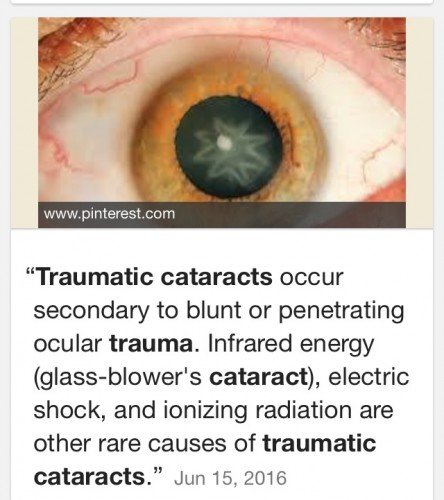
The only reason I did something is because we met our deductible. In January Eli had a horrible ski accident, which resulted in a seriously fractured jaw, which required a titanium plate, tooth extraction, and having his jaw wired shut. He could not chew food for two months and lost thirty-five pounds. With our deductible met, Dave suggested we see the doctor for anything we thought we might want to take care of. I knew I had not had my eyes tested in a while and the blur was a little bothersome. With risk of pre-existing conditions soon counting against me, I decided to get my eyes checked out. Mind blown. I have a traumatic cataract. And understandably, my diagnosis caused some confusion, especially with me. See, several years ago I thought it was strange when a cornea specialist said that I had cataracts, or better, said that he could see my cataracts. He suggested it would be a several years before I needed to address “them.” Herein lies the confusion. The specialist was expert in corneas, not cataracts. There is not a “them.” There is a, “one.” And one blinding cataract may have a different diagnosis. In my case, it does. Still I was caught off guard, he explained my scans and explained my diagnosis. Still did not make sense.
“Don’t cataracts come in two?” I thought.
Thankfully the surgeon realized that my processing speed needed a minute as I absorbed the shock. That is when he asked me to come back before surgery.
“Seriously. Look it up. Think of questions. Research. I can answer any of your concerns. And yes, the diagnosis is a classic traumatic cataract. Oh and by the way, when did you hit your head?”
Information on Traumatic Cataract from Google
I did hit my head, and hard. Nearly ten years ago I went airborne and fell down my friend’s stairs. It was an unfamiliar house and completely dark. I went over a baby gate and landed on my face. I broke my nose, ruptured a cyst in my wrist, and damaged my optic nerve. In fact, even now the skin sensation on the left side of my forehead feels different than the right. And no, I was not drinking. Crazy!
Easy E long boarding at the house where I broke my nose, Park City, Utah, November, 2007
You still may doubt or have questions. I did too. So before I go any further, let me clear some things up. Yes. It is true: everyone will eventually develop cataracts. If you’re reading this, you probably have them this very minute, and if you live long enough, you’ll probably need surgery to address them. Normal cataracts tend to affect both eyes. When vision is bad enough, surgery is performed on one eye and after that eye heals, surgery is performed on the other. My mom recently had cataract surgery and her mom, mom grandma, had cataract surgery too. And it is possible that one eye may need surgery a year or two before the other, but they are close.
The boys and Wawa (my mom), May, 2017, Salt Lake City, Utah
It is my understanding the cataracts are a natural product of the aging eye. My doctor put it this way:
“It is like every year someone puts a dropper of milk in a glass of water. Eventually the water becomes too foggy. And because the glass is yours, you get to decide when has become too foggy.”
Ultimately, it is our ability to see through foggy-water combined with the speed in which the fogginess impedes our vision that dictates when we are ready. As a result of these factors, not all of us will have surgery. We may die first (for real).
In my case, my left eye has a barely noticeable and typical cataract. It will probably be many years before it gets bad enough to fix. On the other hand, my right eye looked like a firework exploded in my lens. When given a glare test, I was completely blind. I would get my questions answered, yet surgery needed to happen regardless. Deep breath!
Even though it was confirmed that I could not see, I was crazy terrified the week before surgery. I was anxious. The risk of losing my eyesight altogether weighed heavily on me. I tried talking myself out of the surgery so many times, and I tried to cancel the day of. I convinced myself that I needed to be at the boys’ track meet. I even told the nurse,
“I should reschedule. They both run today. I do not want to be a bad mom.”
Image from the 1985 movie, “Cocoon.”
The nurse was kind and accommodating and told me that I had until 1PM to let them know. I waited until 12:50 PM to give them go ahead and I needed to be at the hospital by 2:15 PM. At that time, I walked onto the set of the 1980s movie, “Cocoon.” That is, I walked into the Moran Eye Center at the University of Utah. In a sea of delightful old people facing the same surgery, I waited. Because I barf 100 percent of the time after having morphine, the anesthesiologist opted not to give me pain medicine. Instead she used topical numbing and anti-nausea medicine. Of course they give you anti-anxiety medicine too, considering the fact that you’ll be awake while they poke your eye with sharp things. At approximately 3:30 PM MST, the surgeon began. He and the male nurse covered my head in a big white sheet with a hole. As the sticky parts around the eyehole adhered to my top lashes, I heard the doctor say,
“Let’s do this again. We don’t want to hurt those lashes.”
They lifted the sheet off of my face and repositioned the big white cover. Then they attached something to hold my eye open.
“How are you doing?” the doctor asked.
“I am good. This is so weird. Really weird.” I responded.
He cut into my right eye. I was awake. No. Really. I was awake for the entire surgery. And I remember it. About five minutes in, the doctor asked me,
“Beth, can you feel anything?”
“Yes.” I said and followed, “Is it supposed to hurt like this?”
“No.” he responded and then asked the anesthesiologist to give me more numbing medicine.
I could see colors. I heard the surgeon as he worked my busted cataract out of my eye.
“We are ready to put the new lens in.” the doctor said.
As he placed in my new lens it became stuck at the edge. “
“We need to fix this part. It is getting stuck on the edge.”
We were at minute ten. The doctor asked again, “Beth, can you feel that?”
As I looked at the bright whites, reds, blacks and blues reflected in the mirror above I said, “Really, is it still supposed to hurt?”
“No. It is not.” He responded and continued. “Please give her more medicine.” He instructed.
Me, post surgery, wearing my “Hannibal Lecter” Eye Mask, Salt Lake City, Utah
In twelve minutes my surgery was complete. The average time for cataract surgery is ten minutes. I’ll give the extra two minutes to the snag in my lens. When I came back for a follow-up the next day the doctor asked me about my experience. I asked him,
“Is it normal that I remember the surgery?”
“Yes.” He responded.
“Even all that pain.” I asked.
“The numbing medicine is supposed to last 15 – 20 minutes. Yours lasted five. Some people metabolize medicine really fast. You are one of those people.”
After surgery I was traumatized. I could remember the pain and remember the procedure. I could not get over the fact that I was awake while the doctor sliced into my eye. As a result of my processing overload, I asked Dave to drop me off at home so I could catch my breath. I assured him I would be ready to go to the boys’ track meet after he returned with my prescriptions. Yes, I was still trying to make the track meet. Three hours later I woke up. The track meet was over and the boys were on their way home.
Me, post surgery, May, 2017, Salt Lake City, Utah
As I kept opening and closing my right eye, my blind spot was gone. My vision is crystal clear in my right eye and a bit duller in my left. The boys were back home. They were kind and grateful I was ok.
Before I left for my check up appointment the next day, after about half of the way in, I realized as I put on my eyeshadow that I could actually see my left eyelid. I looked closer and kept thinking about all the freckles on my face.
“Wow! I love my freckles. Man, I have a lot of them.” It honestly took me a few minutes to connect the dots as I thought to myself, “It is my new robot eye. It is allowing me to see. My freckles have always been this bright. Wow!”
The boys and I on our Mothers Day Adventure, Liberty Park, Salt Lake City, Uta
Later that day Kyle and I went on a walk. I kept staring at the mountains to the east. I saw contrast. I saw peaks. I saw canyons. I have not seen the mountains like this in years. Then I saw the leaves on the trees. No longer were they a blend of greens. In high contrast I saw each leaf. From blur to high definition in twelve minutes, I still cannot believe it. By the way, I also noticed my bathroom is much dustier than I imagined and that I have a lot of wrinkles. Nevertheless, I am grateful.