Mormon Me, Coffee Me, and Coffee is My Church

I spent my entire youth trying sincerely to adhere to all of the strictures and standards the Church of Jesus Christ of Latter Day Saints expected of young people, while growing up in the Church and eventually attending Brigham Young University. The pressures and expectations eventually overwhelmed me, and half way through BYU I let loose and allowed myself to break the rules, which involved drinking alcohol and engaging in premarital sexual activity. It didn’t happen all at once. I would break the rules and feel guilty and repent, then transgress again and repent again. Over many years, I eventually came to see the Church’s prohibitions on drinking and its purity standards with some nuance, and I allowed the guilt for my transgressions to fade. A few times, in my attempts at 20-year-old-college-student authenticity, I nonchalantly drank coffee. When I did, I was haunted with a heartbeat of thoughts. I knew with every fiber of my being that every sip was pushing me farther away from my eternal salvation. I am not kidding. I don’t understand it either. My fear of coffee’s wrath was deep and far reaching. Somehow, among all of my rebellious transgressions, coffee drinking stood alone. Maybe because the coffee prohibition is unique to Mormons, its violation is most especially policed by the community, an outright rebellious act, and therefore it prompted a feeling in me of the most foul betrayal.   

Instead of coffee, I sourced my caffeine by drinking copious amounts of Diet Coke. I drank so much Diet Coke that I’ve developed an aspartame sensitivity and can no longer drink Diet Coke without getting a migraine. During this era, the LDS church also disallowed drinking caffeinated soda, but the taboo against Coke was never as strong as the one against coffee, and most people, even at BYU, turned a blind eye to a Diet Coke addiction. I needed a Diet Coke replacement at the same time I was drifting away from Mormonism. That is when I shifted to green tea. 

I was not able to simply drink green tea, however. Though I no longer attended church, my moral compass remained synchronized with LDS doctrines. I worked out a rationale that because green and white tea are the non-oxidized (non-fermented) type of the tea leaf, (black tea being the oxidized type), that drinking green tea was not violating the Mormon Word of Wisdom, in the same way that Mormons can drink grape or apple juice, but not wine or cider. Even after I was completely inactive in the LDS Faith, I continued my green tea superstition, which conveys to me now that I wasn’t just freaked out about coffee. I was paranoid about the eternal consequences of drinking coffee or black tea. 

Green tea felt safe and kept me one step into my faith, which out of a similar superstition, I was fearful about fully leaving. Deep down, I was daunted by the idea that if I completely abandoned my upbringing, something super bad would happen to me like a piano might fall out of a window just as I walked by – killing me – because I deserved it. Nevertheless, my tea habit was a bit of a nuisance. Because green tea is light on caffeine, I drank it throughout the day. Ask Dave or my kids. They were always good sports. When we traveled the world, a world with super easily accessible coffee shops, free coffee at car rental dealerships and hotel rooms with more free coffee and coffee pots, I would find a way to procure green tea or white tea. They would never complain and instead helped me locate my favorite teas like the now retired Clipper White Tea Vanilla. Sure, many hotels have tea in the room. It was typically decaf or black. I preferred my tea with almond milk and little packets of stevia. It is my experience that the odds are high that even if there is green tea in the room, most hotels won’t have what I need. I started packing tea and stevia in my carryon. Everyone knew I drank copious amounts. My favorite tea order: Starbucks Venti Green Tea Unsweetened Light Ice.

Then two years ago I found myself on the brink of death. (I am not exaggerating.) I had been terribly ill for several months, including an continuous, choking cough that prevented me from speaking and that sometimes left me on all fours unable to take in a breath, severe chills, night sweats that soaked me head to toe several times during the night, sudden weight loss, fingernails peeling off, pallor, chronic tachycardia (my Apple Watch noticed my tachycardia and saved me twice by warning me to go to the hospital immediately). I spent months in home isolation, filling my days checking in with my doctors, seeing specialists, having endless blood tests and while I was surviving alone on my couch, watching the reality tv show “Alone,” about people surviving alone in the woods.

On a cold, late autumn afternoon I found myself at my allergy appointment when my internal medicine doctor called:

 “It’s serious. Your bloodwork is bad. I’m not sure you’ll be ok. Your blood isn’t oxygenating well. You’ve gone off a cliff so to speak. I want to have you admitted to the hospital immediately. Can you go there now?”

 Dave and I made our way over to the University of Utah Hospital where they were waiting, and spent several days having every imaginable test done, while being carefully monitored. A big part of what they were doing was systematically eliminating every type of cancer and acute illness, starting with the deadliest ones. One by one, we ruled out the various instant death sentences and horrible terminal diseases and eventually I was diagnosed with Anemia of Chronic Disease. Essentially, my bone marrow wasn’t functioning and all my intense symptoms were a result of my system’s inability to oxygenate my blood. My body couldn’t process iron in my diet or with oral supplements. I learned I would need iron infusions for the rest of my life. I received my first infusion in the hospital and for the next year, I had my blood tested every four weeks, and received fifteen additional iron infusions. 

During that time I became aware that, besides having a few autoimmune issues, another thing that could be blunting my iron absorption was caffeine. See, I sipped my cups of green tea all day long, including at meals when I was receiving nutrients. As I became more run down, I craved a caffeine boost even more, and that created a vicious cycle. In my vulnerable state, my body wasn’t able to do what it was supposed to. I wasn’t getting iron. I was tired of being tired, and tired of feeling and thinking like I was going to die. I did constant research trying to figure out what I could do to get my body to work. Then in the Summer of 2024, I read that it’s easier for people with chronic anemia to absorb iron if they get their caffeine in one big dose at least an hour before or after meals, (as to not inhibit absorption). Honestly, I was probably drinking so much caffeine (like all my life) because I had undiagnosed celiac disease and as a result was already not properly absorbing nutrients. 

That is when a miracle happened. I thought to myself, “What if I drink coffee?” I started low stakes and bought a can of Starbucks Medium Roast instant coffee. I heated up a cup of hot water, used a ½ teaspoon to measure my servings. I already had become accustomed to frothing almond milk for my tea. I made the switch. I began spending an hour or two in the late morning each day sitting at the northeast corner of our kitchen island, drinking two cups of coffee. Coffee became my church. I frothed. I read. I wrote. I sipped. 

Because I fear their Mormon judgement, I intentionally withheld my new “church service” from my family, especially my mom. My coffee time became sacred. It was my new religion. I shared how much the switch to coffee helped. Dave quickly picked up on this new space. I didn’t excuse it. I owned it. Occasionally he would forget, walk into the kitchen, see my sipping or frothing and say,

“Oh wait. Is it coffee time? I can wait.”

I loved him for respecting my boundary.

Soon, I started feeling well. I don’t want to make a spurious correlation and suggest that coffee is what moved me to better health. Then again, maybe it was the space I gave myself to have coffee and to feel good about myself. On Christmas 2024 Dave gave me a Moccamaster, a fancy pour-over coffee brewer from The Netherlands that looks like a chemistry set. He had purchased it at an auction—it had been returned because it had some chopped paint. (I think he paid $23.00.) 

“Don’t worry. If you don’t like it. It’s no big deal. We can give it away.” He said. 

Thanks in part to the lack of fanfare and pressure, I purchased a coffee grinder and embraced the ritual of grinding the beans and working the Moccamaster, and it became a keystone of Coffee Time.

Shortly after that Christmas, I was on Facetime with my LDS sister when Dave eagerly announced, 

“Beth is using her new coffee machine.” 

My shoulders tightened. I couldn’t force my sister to unsee our coffee machine. I felt the shame of someone who had committed a major sin. I felt an urge to confess – to her. I started rationalizing and explaining why I needed to drink coffee. I hung up the phone, my face red with shame. That is when I decided I didn’t need anyone’s moral approval or permission to drink coffee. I never looked back. 

We found the right cone-shaped coffee filters at Costco and I fully transitioned from instant coffee and learned to brew an excellent pot of coffee. A local roaster, La Barba Coffee, is my favorite. I love their House and Anchor varieties. I’ve gone through several frothers and am glad we purchased the extended warranty on the Kuerig Brand frother. (I’m currently on my third Kuerig frother.) I’ve taken our backup frothers all over the world, including to Chile where we hiked the W Trek in Torres Del Paine

Last week I opened my 2025 Christmas present: a Breville Bambino Plus Espresso Machine. It’s cute and shiny! Kyle, my oldest, gave me a coffee subscription and two coffee mugs, one is a double walled glass mug and the other a personalized Prospect Lefferts mug & Brooklyn Botanical Garden coaster from the NYC nieghborhood he lives in. The learning curve wasn’t as steep as I thought it would be. I learned why we tamp, how to tamp, and even bought myself a tamping station. By the end of the week I was making the perfect-for-me Americano. We spent the entire holiday talking, connecting and making coffee drinks. 

The other day, Kyle had been visiting for Christmas and participated in the espresso festivities, said he already missed my espresso maker. I sent him a picture, which he promptly “hearted.” As I reflect, I don’t understand why I let coffee or the idea of drinking coffee terrify me and allow it to be some sort of measure of my worthiness. I wish it wouldn’t have taken me almost dying to internalize that drinking coffee wouldn’t cause my eternal damnation. I respect that people have their own relationship with coffee, tea, or “strong drinks.” I grieve the years I didn’t drink coffee and am relieved that I finally feel safe drinking coffee on a regular basis. Maybe some day I’ll be brave enough not to hide my habit from my Mormon family. Ultimately, my body loves coffee. I feel healed. I love my new church. I love my coffee and I still drink tea — all the flavors.

Tagged : / / /

CrazyUS Squad Goals

Hey there! It’s been a minute. Happy 2026!


I have no idea if online posts are real or just some form of AI Slop – (“AI Slop” is also Merriam Webster’s 2025 word/phrase of the year). With Social Media so full of this SLOP, I decided I wanted to be a real human who blogs/writes publicly (finished another draft of my memoir recently). I’m craving authenticity! Sure, my words might fall into a vortex only to be read by my husband and bots. Nevertheless, I love to write. I love to express myself. I promise reliable and relatable truth. I hope you will find me. I hope you will engage. 

Recently, I learned that because CrazyUs Dot Com is so old (birthed in 2002), it has a high Google Trust Worthiness Ranking System, which I thought was really cool; (or possibly meaningless, depending on who you ask). Dave (my husband) and I have been talking about the experience of being an Old Time-y Blog or website. He started OS News Dot Com in another century. It still has like 2 million monthly visitors. 

My children are grown and living their own lives. Like a million years ago, on the daily, I used to regale the world with stories about raising two precocious little boys. Each day brought new joy, like son-guided safaris equipped, including sippy cups & winter hats, poop painted walls, or homemade robot costumes fashioned out of cardboard boxes. I had no idea that establishing CrazyUs way back then would help us maintain a solid online footprint. I mean, it was an era before social media where people in real time would reach out and long form comment or respond via email, and then we would email back and forth for days, building beautiful friendships. YES! Email! I miss that time, which seems like a blip on the radar of technology’s progress, because it was a blip.   

I’m (so) much older now. Many of you have zero idea what a blog or a Mommy Blog is and that’s totally ok. Anyway, back when I was a Mommy Blogger, I personally came to know my audience, considering many of my readers’ real life friends. I loved sharing joys and heartaches and looked forward to my daily real human connections. I loved talking with other parents about their children. I was moved to tears by others’ stories of infertility, which I was also experiencing. I found a community of women and men who really seemed to care about one another – because they did care about each other – on a personal level. Back when we were trying to decide if it was safe to enter our credit card number to make an online purchase, blogging was this bright light in a sea of the new World Wide Web. 

Somewhere in there my best friend, Heather (Dooce.com) – who died in 2023 by suicide – may she rest in peace – well, somewhere in there, she and I had a famous online breakup (a burn-it-to-the-ground falling out, which I have learned since was just her style. I was the first on her long road of burning bridges.) She often protested,

“Beth, I am the bane of your existence.”

She was not the bane of my existence. I only wish whatever was broken hadn’t clouded the love and admiration I had for her. Selfish, I know. I’m a classic adaptive caretaker / enabler. Heather (Dooce) and I, in-therapy-speak, were a toxic match. In those early years, she was cool, well spoken, thoughtful and such a great writer, a fabulous friend, and yes, eventually she became mean, vindictive, paranoid and progressively unhinged. What a heartbreaking loss! She and I never reconciled. I hope if there is a life after this one that she has found peace. Nevertheless, Heather (DOOCE) absolutely owned Mommy Blogging. We all knew it and loved-hated her for it. 

That is possibly why Beth of the early aughts was no match for Heather/Dooce’s power and influence. As it turned out, Beth-of-yesterday ran away and stopped blogging.

I moved (literally). When the air cleared, I realized my pain was never about blogging. That is when I decided it was time to break the unhealthy generational cycles within my own family of origin, (where my significant pain lies). Thanks to therapy, boundaries, a husband who is committed to work through the shit, and two amazing children, I’m absolutely wiser, stronger and happier. I feel joy. I drink coffee, (the Mormon thing because Mormons aren’t supposed to drink coffee, but can binge out on Red Bull. Make that make sense.) I no longer hide who I am. I feel like me. Sure, there are wrinkles. Some of my family no longer speaks to me. It balances out, because there are other family members I have chosen not to speak to. Consequently, these days those of us who do speak usually keep it about the weather or our health.

Here is a truth: Beth-of-Yesterday may have remained a blogger had she been more confident and had not relied so heavily on the support of her family. Feeling supported was a tall ask. It makes sense why yesterday-Beth caved when her husband proclaimed,

“Blogs don’t make money!”

Beth-of-yesterday’s mom frequently shared,

“What you write hurts and embarrasses our family.”

Of course I couldn’t see what I had. I ran from future opportunities like my blog moving me into some sort of social media job. I ran from my community, which I do regret! I realized years ago that I could never reclaim that moment because that particular Mommy-Blog-Hailey’s-Comment time and opportunity will never come again. 

What I can do is serve as a cautionary tale: TRUST YOURSELF! IF YOU CAN, FOLLOW YOUR DREAMS, even when your dreams make others uncomfortable!

What makes me happy is Beth-of-Today! She has grace. She understands that her husband had no clue how much money bloggers could make as they transitioned into influencers and that Beth-of-Yesterday should have pushed back on the patriarchy so-to-speak and listened to her own innate instincts. Alas, Beth-of-Yesterday was raised in a patriarchal religion by a mom who really thinks men are our bosses. I absolutely wish Beth-of-Yesterday had not given her power away to her best friend, her mom or her husband. Regardless, I have compassion for young Beth. I didn’t get it! I didn’t see that I was enough! My therapist often suggests that I was raised not to get it; and that actually I was conditioned to give my power away, (because I was. I mean, look at Mormon theology: men are literally the patriarch of the home).

I’m still working on forgiving myself.

What I can tell you is that since way back when, I’ve come to learn that I carry and abundance of fear and shame, which I’ve carried from a time before I had the words to say that I felt worthless and afraid. Consequently, my relationship with my family really had nothing to do with the words I wrote online. And in fact, keeping their secrets has arguably made things worse. I will probably always be working on shaking the fear and shame. What I finally see, however, is that my family, including me, is strong. We are survivors! We will survive regardless if I publicly share one of our uncomfortable moments.

As far as all-of-me goes, it makes sense that had I kept blogging, I would have moved into a career in social media — like so many other Mommy Bloggers did, which is another loss I’ve had to grieve. Agism is real and I don’t have a time machine.

As far as what I write, I’m certain that I cannot buffer everyone from the pain my word choice might evoke. I’m sure my revelations will hurt, embarrass or offend someone. They inevitably do. Then again, is anyone even reading?

To my family: Please know that I don’t want to hurt you.

I’m here. I’m real. I hope you will read. If I hurt you or you don’t like what I say, I hope you will talk to me. Let’s keep this going. Happy New Year. With love. xx Beth 

PS Dave, if you are my only reader, I am grateful you are here reflecting back my words. What a gift.

Tagged :

The LDS Garment Change: Paralyzed by my despair and reminded of all of those cap sleeves

I was raised in the Church of Jesus Christ of Latter Day Saints. I learned through a post written by the Salt Lake Tribune’s Peggy Fletcher Stack that the women’s garment will now be sleeveless. This change makes me mad. (Yes. I know the rules have changed before. Before 1923, garments had full-sleeved legs and arms.) My assumption is that I will be criticized for complaining or for not having a testimony of the restored gospel of Jesus Christ:

“Shame on you for bringing up the coercive control you felt yesterday. Don’t you know that everything is better now. This is God’s loving way of adapting the rules for his children. [Your thoughts] are thoughts seeded by The Adversary [used] to stir people up to feeling slighted and then justified in hating the church.” 

Sure. [insert my shoulder shrugs here]

Even if an evil force is influencing my thoughts (I don’t believe one is), I have real feelings that actually need to be addressed. Others, like Lindsay Hansen Park, have beautifully addressed these LDS garment changes more concisely than me. Nevertheless, I believe all voices matter. That is why I am offering my perspective here. 

I am struggling to see beyond these triggers and my innate reflex to behave and not embarrass my mom. From what I have read online, I am not alone. I have been sitting in my chair for hours, paralyzed with grief. What do I do with all the shaming and shunning now that the rules change? Will people be able to openly drink coffee tomorrow (and without sneaking their minivan through a Starbucks drive through)? I am perplexed and confused.


The trauma resides tucked away in the cheap polyester fabrics and sweaty crotch of my Mormon underwear. When I stepped away from Mormonism I left my bedroom drawer filled with my newly washed LDS garments. For years my garments remained untouched. I was superstitious and haunted by thoughts of bad things happening. As I walked by my dresser drawer I was consumed with visions of crashing airplanes. Instead of there being a perfectly preserved garment-covered-torso-display-of-my-worthiness, there would be nothing left—all because I chose not to wear my Mormon underwear!

I believed I would be punished if I threw them away or gave them away. Eventually I needed the space and determined it was time to empty the drawer. I heard there was a special way to dispose of them and I did not want to get it wrong. Something about cutting out all the symbols and putting the symbol part of the fabric in a different trash can. Ultimately, I left the drawer alone – (until we moved). I did not want to break my Mom’s heart. Emptying that drawer would signify that I was one step further away from who she thought I would be. It was one step further away from her dream of a family reunited in the Celestial Kingdom. I couldn’t do that to her. I would find a way to wear those garments again, even if it killed me.


A few years earlier we were at the National Mall in Washington DC. I was five months pregnant. My husband and I met up with some friends; we were waiting to watch the Fourth of July fireworks. It was like a billion degrees outside and maybe five-hundred percent humidity. I was wearing a garment-covering outfit: a dress that went down to my knees and sleeves down to my elbows. I wished I was wearing a dress more appropriate for the summer heat, like a sleeveless dress.

Soaked in my own sweat, my hair out-of-the-shower wet, perspiration dripping down my face, I was resolved to air out my garment-soaked boob area. I pulled up on my bra, which was resting on the outside of my garments. Then I unsnapped my bra, leaving it draped across my chest. My crotch began to itch. I tried to re-snap my bra because maybe I should be more obedient. Next I hoped to discreetly adjust my bunched up Mormon underwear, which was firmly trapped up my nether regions. I feared contracting a UTI which would only make my already complicated pregnancy worse. In this sea of thousands, I whispered to my husband, “It is dark. Do you think anyone will notice if I take my clothes off?” As the words left my mouth, I was wracked with feelings of shame. I had covenanted to my Heavenly Father to wear these garments as a show of commitment to live a good and honorable life. The words of my sister ring through my head as she exclaims and points at me from across the room,

“OH MY GOSH! YOU ARE NOT WEARING YOUR GARMENTS!” (She has since left the LDS Church.)

The shame I felt in the moment she called me out is a shame I carried with me FOR YEARS and it was the shame I felt while sitting on the National Mall. My clothes stayed on. So did my bra. So did my Mormon underwear.

I knew someone would notice. I preemptively felt their side eyes. Women check. We always compare each other. We check garment lines and skirt lengths. I recall an experience my mom had as a new convert to the Church. She wore a sleeveless dress to Relief Society (the women’s organization meeting). The Mormon missionaries had neglected to tell my parents about the temple garment (and the requisite de facto dress standard it requires) before baptizing them. Consequently, instead of learning about this special commitment you make to God by wearing His sacred underwear ahead of time, my mom learned about garments through social shaming. Instead of having grace for her, the church women let her know that what she was wearing was not “what we wear here.” The trauma is deep rooted. Until this week, that trauma manifested through checking sleeve length. 

And really, it’s not just garment lines Mormons check. Maybe that is why I am upset. I don’t mind that the rules change. What I mind is the coercive control and shaming based on arbitrary rules and systems I experienced. What am I supposed to do with that? When I needed help on my mission, I called home. My mom did not want me breaking the rules, and I was breaking the rules. My mom asked my brother to talk to my mission President to tell me not to call home. He did. My mission president spoke with me. I was disciplined and admonished that I needed to have more faith. Now the Mormon missionaries are allowed to video chat with their family each week. Why was I wicked then for doing what’s righteous now? Where do I set the humiliation and othering I experienced from my family and my faith?

Tell me I need to be happy about God’s love and letting the Mormons drink caffeine on BYU campus and now having sleeveless garments. Regardless, if the Atonement and Jesus and rules that change to help members of a certain dispensation are all real, there is also a flip side. These shifts don’t repair damage the old rules caused. To be a member in good standing, for starters, I need to be baptized, worthy, a full tithe payer and work to attend the temple, which includes wearing the temple garment. I wonder if The Church of Jesus Christ of Latter Day Saints would consider their own accountability by following their own teachings and a spirit of Christian forgiveness. (I am not holding my breath.) If they do, I would suggest that these sleeveless garments and their makers apologize to those of us who bore the weight of this arbitrary rule and its accompanying coercive control. I would hope they could work to heal and repair the damage they caused no matter the shifting rules or changing hemlines, that they could tell a young me and all the people like me that we are worthy and we are good. Calling home on a mission during a health crisis was not Satan’s influence, nor was abstaining from wearing garments during a hot DC summer while pregnant. (Yes. After the fourth of July fireworks I took some lifesaving measures to not overheat and to save my baby. Some days I chose not to wear my garments). 

Copyright 2024 CrazyUS.com

Why a memoir: an exposition, including journal writing 

For like twenty years, on and off, I have been working on my memoir. Really. Stops and starts. That is what it has been. I test the waters. When I do write about a family member, or suggest to family that I might be writing my story, I am often met with pushback and threats. I shut up. Like I am trapped in a sinking car, I want to breathe so I stop writing. As I surface, I realize that my words want to come out. Honestly, I wish my family understood that this is my story, yet I don’t expect them to. I don’t want to share their secrets or make my story them about them. Instead, I offer them grace. I take deep breaths. I go to therapy. I write privately. When I do freak out or worry about being sued, (yes, I have been threatened), I think of the words of writer Anne Lamott:

We write to expose the unexposed. If there is one door in the castle you have been told not to go through, you must (open the door)…You can’t do this without discovering your own true voice, and you can’t find your true voice and peer behind the door and report honestly and clearly to us if your parents (or siblings) are reading over your shoulder. They are probably the ones who told you not to open that door in the first place. You can tell if they’re there because a small voice will say, ‘Oh, whoops, don’t say that, that’s a secret,’ or ‘That’s a bad word,’ [Instead]…Write as if your parents (and siblings) are dead. 

I have lived another entire lifetime since I first had a story I wanted to tell. I married. We had two beautiful sons. My heartaches like infertility, suffocating loss, and serious health crises have (hopefully) filled me with compassion and the ability to confidently and lovingly share my truth. I have taken that time to learn how to set boundaries and break cycles. I am a work in progress. I know my past lurks in the shadows, and like cocaine in the 1980’s, it begs me to repeat its dysregulated patterns. 

In 2020, out of things to sanitize and masks to buy, I started getting serious about my life story. We (like the world) were stuck at home. In our case, our eldest son was ripped from his dreamy Sydney, Australia Study Abroad. His girlfriend, who was studying away in Paris, was also forced to leave. She moved in. A month later, our youngest graduated from high school in an eleven minute drive-through ceremony at a local park, including a picture with his principal and returning his cap and gown correctly on the hanger on the rack situated on the park lawn. 

We were (still) trapped at home. As the parent, (whatever that means), I tried not to make things worse. Our house was really clean, especially our kitchen counters, which I repeatedly washed out of sheer boredom and maybe germs. Our pandemic-addition was nearly complete, which included expanding our master bedroom and the one below. Out of counter spray and maybe a little loneliness, one morning I began digging through our storage. I happened upon my old journals. I picked one up and began to read from February 11: “Today is Dad’s fiftieth birthday. Two weeks ago he told Mom he doesn’t know if there is a God.” I read on and was hooked. A few pages later—April of that year—I wrote, “Well, Mom and Dad are really getting a divorce.”

That night I told my husband about hours I spent reading. Enthusiastically he urged: “These are primary source materials. Use them in your memoir!” It had never occurred to me that I could use the assistance of my childhood journals to tell my own stories. I said right out loud: “Dude, you are a genius!” I decided to see how I could infuse my journals into my story. 

Of course. See, it was my mom who taught me about journals. After spending the day reading and reflecting, I wondered if Mom used her journals to record the bad feelings and fear of God, the obvious echoes of her own trauma. Nevertheless, in the corner of our dusty storage room it was clear that Mom’s own trauma and journal-keeping were ingredients in what I would call my epic narrative; a crucial ingredient like flour or eggs. 

As I read, in a flash of big “I am being followed down a dark alley” feelings, memories of my past flooded in. I felt the dread of Mom’s constant, “I have a bad feeling. Did you pray?” I continued reading as my ominous feelings were validated: “Mom” literally had a “bad feeling.” I thought about my mom. I wondered if her need to feel safe and in control were constant, and were easily reflected in her daily rituals and routines, like writing in her journal, reading her scriptures each night and kneeling in prayer. 

I recalled seeing her, scriptures open, reading and highlighting. 

She would explain, “The Mormon prophet and leader of our church proclaimed that for us to receive Heavenly Father’s blessings we need to read the scriptures for at least thirty minutes a day.” 

Once she finished her thirty minutes, she meticulously brushed her teeth, made her way into her room, knelt at her bedside and said her prayers. “The prophet has also asked us to pray for thirty minutes each night. I can’t let him down.” I often found her asleep, still kneeling at her bedside. 

The part of her routine I was most intrigued with was her commitment to journaling. Journaling wasn’t just a novelty, quirk or affectation. It was my mother’s adherence to a specific admonition from our church leaders. Before her scriptures and prayers, Mom, dressed in a flannel nightgown, found her way to a quiet corner, which usually was our upstairs yellow and brown-colored, plaid couch. Holding a ballpoint pen in her left hand, (I am also left handed), I watched as she began writing words in a large notebook: 

“Mommy, why are you writing in that book?” I asked. 

“I don’t always remember everything. I want to keep a record of our life. Our prophet has asked us to keep a journal. I want to follow the teachings of our Heavenly Father.” 

I felt Mom’s urgency to follow God’s commandments. Consequently, when I was seven years old I asked Mom for my own journal. 

“Oh Bethy, Heavenly Father will be so proud of you.” 

Then one day she handed me a journal. I hoped God would take note. Writing came naturally. So did processing the world around me. 

In what some might call “exhausting detail,” I logged my daily life. When I did not log my life, I felt like I was letting God down.

Picture a piece of lined notebook paper. There are two to four words per line with twice as much space in between each word. The page is positioned in a 1.5” mustard yellow spiral ring binder, next to a cardstock cover of a bible coloring book called, “The Life of Daniel,” (You know, Daniel, the guy in the Bible saved by God as he sat in the Lion’s den.)

My first journal entry:

“This is the story of my life. When I was four I moved in a new house. It was fun but sometimes I was sad…”

Out of some obligation to God, or probably because I really enjoyed it, I never stopped journaling. I wrote what I saw or wanted to know, which led me here to sharing my story. As I did research for this memoir, I followed through and reviewed thousands of pages from my hand-written diaries, from that very first journal entry to the laptop I write in today. Through the years, my life’s experiences have been edited, mellowed and recontextualized into the memories that live in my head. As I read my writing, my own primary sources, including pages that I may not have read since the moment I wrote them, I have come to learn that my actual memories are much softer than the words I found hidden on those pages. Not only had I forgotten many painful, horrible events, the experiences I did remember have been worn smooth, illuminated with compassionate light. 

As I read my childhood journals with a grown up understanding, I am amazed at all the buried, dark family secrets and revelations that have emerged. Truths were waiting in plain sight, if not always in plain language. I wrote around the brokenness. I left out the specific details, like how loud I screamed or how many times I cried myself to sleep or woke myself up in a cold sweat.

In my case, my writing became less about fulfilling an obligation and more about me. What I observed, which I am still trying to reckon with, is that I wrote about my traumas so casually that it was as if expressing them were as normal as blowing your nose—as mundane as watching television with an old remote control. I wonder if me of yesterday hoped that me of today would be able to decode those empty, clearly identifiable spaces shaped exactly like each specific trauma. I am here to say, “I think so.”

This became my writing practice: I watched. I observed. I processed it. I could not stop taking it all in. I loved taking it all in. I analyzed and deconstructed everyone and everything as a means to understand the world around me. I talked about what I saw: “Mom, did you see the man on the street? He was wearing a brown shirt and green striped pants. He wasn’t wearing shoes. I wonder if he is cold.” Mom was a great listener. After I exhausted my voice, and probably my mom’s ears, I wrote everything down. 

My journaling is vivid. I am curious. I am interested. I love human behavior. I love how people interact. I absolutely love human connection. As such, I receive the world through the lens of relationships. Asking my mom and dad about sex at the dinner table as a nine-year-old completely made sense and had no bearing on the fact that my two older brothers and three older sisters were sitting around that table with me. I would also argue that there is a human need to construct and reconstruct which gives voice to our story, authority and ultimately healing to our lives. Ultimately, with all my observations and questions answered and then recorded in my journal, my journals have become the reliable narrator in my story. 

I am grateful for Mom’s desire to journal all those years ago and my desire to follow suit. Without those decades of record keeping, I don’t think that I would have a good understanding of the events that shaped me and set me on my course, and I would not be able to understand my own mind, my personality, or my family dynamic as well today.

By the way, I certainly do not claim to be the world’s best writer, observer, human, wife, mother, sister, daughter or friend. I am a storyteller. We are human. I am human. I believe that we are here to heal, to forgive and to learn. This is my hope.

More to come…

My Words. My Story.

CrazyUs.3.16.17.1

Preface. I wrote this post last night.  I told Dave that I would not post it online, and would keep it with all my other working-out-my-religion posts.  Please know I never want to offend. That is why I try to leave my beliefs offline.  Also know that I am posting because this post is not about beliefs or doctrine. It is about community. Earlier today my friend, Amy in Texas, reminded me that maybe we can have a productive conversation about building community when she posted this Salt Lake Tribune article. It  was written two years ago. I think the author Paul Malan says it way better than I do:

Each time a non-traditional Mormon lets her neighbor see her unique beliefs, she makes it easier for everyone in the congregation to be true to themselves. One respectful voice at a time, the silent minority will begin to understand that they aren’t alone in their doubts and beliefs. Power will shift away from the monoculture and toward the productive edges  — to the ecotones where opportunity and challenges await, where ideas and opinions and personalities can blend together to create something like an ideological wetland: hard to define, hard to cling to, and infinitely more valuable to the world than anything Mormonism has been able to offer so far.”

My Words: I have been told that if I (a.) did not live in Utah, ground zero of Mormonism and (b.) had never been a Mormon that things would be different. I tend to agree. And in truth, this post is not about doctrinal discrepancies or our political differences. It is about community and my quest to find it here. And I know a big part of our community is measured (on both sides) then based on LDS church attendance and activity. Out of the gate, let me complicate that measurement. See, if I did not feel such a bizarre expectation when you see me at church, I would probably go. And in the interest of full transparency, yes, I would not attend full-time, but I would definitely go when I was feeling nostalgic, or wanted to connect with a very big part of who I am. Hold up. And to my non-Mormon, or former Mormon friends, you may ask,

“Beth, why are you bringing this up? This is not healthy. Draw a line. Make a boundary. Let it go and move on.”

To which I would respond, “You may be right, but why do you care?  This is my story and my experience. And I seem to recall that you were able to have your experience too.”

And to everyone on all sides: Obviously you may think I am crazy for feeling the way I do. Instead of crazy, I would suggest I am grey. Meaning I sit on fences, and fence-sitters are hard to measure or box in. I suffer way too much empathy (for all the sides). Mostly and for real, I love, respect and care deeply about my mom. I know how completely sad it makes her that I do not go. I take her seriously and reconciling her sorrow is hard. That is my uncomfortable truth.

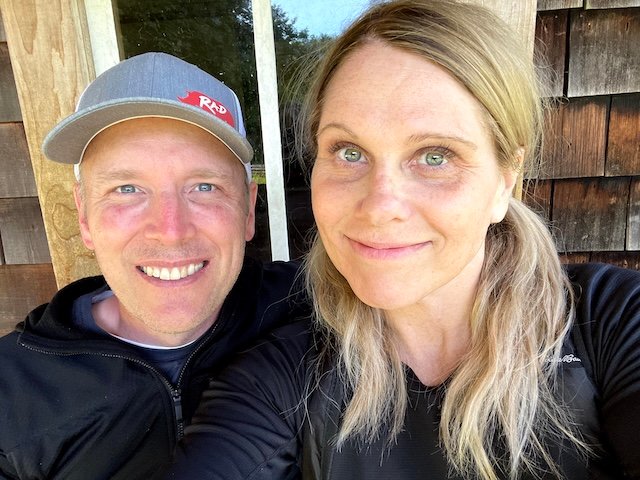
Dave & I at the Natural History Museum, Salt Lake City, Utah

I want all people to feel safe being their authentic selves. That is why I chose to be transparent. And the truth is, because I was raised LDS, and because I live in Utah, Mormonism is and will always be an inescapable part of my reality. I have very fond memories of the LDS community I was raised in. I met my best friend, Marianne, at church, and I met Dave at BYU. It was not all bad.  Eventually after fighting every single Sunday, Dave asked that we do something he wanted to do, which was to stop attending church.  I love him. I support him. I heard him and we stopped. At the time I wrote my local bishop a letter and asked him to include our family in activities. Then the Mormon bishop and I met in person. We had a friendly conversation and I never heard from him or really that ward again.  On a summer evening in a previous ward another Mormon bishop saw Dave and me out on a walk.  He hesitated. Then he stopped and approached. His words:

“I was told not to talk to your family. I was told that you did not want any contact.”

“I am glad you said something now.” I kindly responded as I held my ice tea by my side.

We assured him that he had been misinformed. I pushed further and reassured him that whether we went to church, sat in the halls at church (which we did a lot at that time), or did not go at all, we would would always be nice and open. I said,

“You are our neighbors. I do not think it needs to be so black and white. I hope we can all be friends.” To his credit, he and his wife have remained our friends.

Having a friendly conversation with these bishops are not isolated incidents. If I had a dollar for every Mormon church leader I have reached out to, I could buy a really nice outfit. It is awkward. Because I hope things can be different, every time we move into a new place, I (preemptively) reach out.

“No, we are not drug dealers or pedophiles. And sure, I only have 2 kids, but that was infertility not choice.”

They reach back in an an excessive flurry, usually offering to take our kids to church if we don’t want to take them ourselves.

“Beth, it takes a village. The whole neighborhood is raising my kids.” One man texted me.

I responded, “Hey, if my sons want to go to church, I am happy to take them.” I am certain his intentions were good. I am also certain he does not understand the divisive implications of what he is suggesting: Church is good, Inactive parents are bad (not worthy) = Mormon Ward Members (neighbors) will save Kyle and Eli.

Sure, I wish I could say that my very assertive and sincere, we-can-still-be-friends public relations approach works. It sort of works. Like for a minute. Then when people do not see us at church, or because church responsibilities demand so much attention, we are forgotten, excluded, or awkwardly included. I left my anger and resentment behind years ago. Each time I sincerely thank them and ask them to include me in neighborhood texts, activities, or service. I usually do not hear back. Remember, I know the culture. They are busy.  They are insulated and eventually, they drop off.  So when we do see them, they usually overly share, look down or pretend they do not see us.  It does not matter how many times I reassure them we are more like them then we are not. It does not matter how much I promise not to talk about doctrine, nor does it matter how many times I say nice things about their beliefs.  We are never part of the community.

I am also human. So when we do get invited to a church activities, my memories of how Mormons feel about outsiders kicks in.  I let my anxiety and preconceived judgements get the best of me and I act a little shy. Truth be told, I also persevere and force myself to engage:

“Hi neighbor. I am Beth. Our kids go to school with each other. Both of my boys are on the cross country team.”

The conversation always falls flat when they realize who I am and then they stare blankly. That is when I sense they are simply fulfilling an awkward responsibility to engage with the “inactive” lady. Check. I think you know the difference between a sincere and insincere response. Just in case you don’t I will give you an example:  It is like when your mom forces you to talk to the dorky kid, that kid you would never invite to your party or a ski weekend. It feels just like that. Weird, not normal.

I also get it. I am sensitive to their position. And of course, I have many Mormon friends who accept me no matter what.  Unfortunately, here in Utah, there is no separation of church and state so their better-ness and exclusivity bleeds into the culture. Mormon moms make the best PTA presidents and organize the best running groups.  Again. I get it. To them, I am an unknown. Consequently, I am not safe. I am an outsider. They are human and maybe saying hi to a stranger is really hard.  I imagine they could be gun-shy, because when they do reach out, they are are met with confrontation and frustration. My whole point is I do not need to be a stranger. I literally know and understand your culture. We literally live next to each other. Our kids go to school with each other. I can help you with your PTA stuff.  I am probably more like you than I am like my non-Mormon friends. Don’t you see that? That is why I keep trying to connect. I realize that I may not fit the mold of someone who does not go to church. I am grey.  In truth, who really fits into that mold? I know many of my close LDS friends do not.  I think there are more grays. And #protip, grays usually exist on the fringes. And I would actually argue that the fringes are getting even bigger.  If it helps, do you realize one of the reasons people exist on the fringe is their desire to bridge differences? The grays, or people on the fringes, will always be the first line of people willing to consider other perspectives.

But because I am (peculiarly) determined in my belief that all bridges can be crossed, I keep trying. I am honest and I want to give people the benefit of the doubt. I ignore the truth adjustments, weird excuses, or blatant deflections. Nevertheless, being excluded or labeled, “outsider” sucks. It is no longer about religion, but about tribe and belonging. I think I need help or advice or understanding or to finally find some consistent healing. Does it really need to be black and white? Do I really need to pretend my Mormon neighbor is not there when she is standing right in front of me? I keep writing, talking, and yes, even praying and meditating, in hopes of figuring out and resolving my weird relationship with Mormonism and the Utah Mormon community. Sometimes I think I have figured it out.  In those moments, I feel relief. Something happens and another layer peels away. Then I am reminded about  the incongruities between the inclusive Mormon teachings and reality.

Rest assured. At times, I  too, think I am crazy, brainwashed, or super weird for trying to resolve these disconnects between myself and my faith. I was raised in Minnetonka, Minnesota, where the LDS members clung tightly together in a place where Mormonism was considered a curiosity, and Mormons were definitely held at arm’s length. After feeling the culture exclusion, I swore I would never exclude or do anything to make someone feel less than.  And as fate would have it, I now live in opposite land:  Salt Lake City, Utah, a place where the predominant culture is Mormonism.  And now in this bizarre twist of fate, because Dave, the boys and I do not go to church, we are the peculiarity. We are definitely held at arm’s length, especially in our Mormon neighborhood. The disconnect kind of drives me crazy.  

My question: Why can’t people be normal (or in fairness, how normal like I see normal)? Why is it hard to embrace people on the fringes? Don’t they remember the persecution and rejection their religion suffered?  And really, why do they act so weird around me and my family once they realize we do not go to church?  It makes no sense. Wherever we live, the ward boundary dynamic is always the same. They are fine with us until they realize we are not exactly like them. And when a friend finally connects that we are different, they reflexively close the door (usually along with their friendship). It is so strange.  

Marianne and I, Red Iguana 2, Salt Lake City, Utah

Instead of the norm, I want things to be different. In some ways they are (actually). I want Kyle & Eli’s friends to consistently treat them equally, even though they do not attend Mormon seminary or attend Young Men’s activities. I want the neighbor ladies to include me in neighborhood text chats and group walks, even though I do not go to church. I want the dudes to include Dave on the fun stuff not just the awkward neighborhood football fellowshipping activity.  I want the dads to know that even though we do not go to church, and that my sons are not the LDS sons you want your daughters to date, my boys will always be respectful. I promise. Please know that we are strict. We talk to our boys about consent and we even follow Mormon cultural norms about dating and courtship.

Selfishly, I want to shake them and say,

“Come on. It is us, Beth, Dave, Kyle and Eli. We are respectful and we will not bite.We do not care that you go to church. Why do you care that we don’t?”

Am I asking too much? I do not expect perfection. How could I? We are not perfect. And really, I can be such a dork.  We know and understand you are super busy with all of your church commitments, obligations, and are most likely unaware of your commitment-based isolation (monoculture). Nevertheless it is clear you that unless we do it your way we will never fit in. We will remain the pariahs, which sucks,  by the way, because remember, we are nice. This could be an opportunity to heal or to bridge? And when you do connect, or when you do allow your children around Kyle and Eli, I do not understand why you get a pass and why we always feel like we have to present you with a personal worthiness resume, which includes, but is not limited to, a mention of our prominent LDS friends, our service experience, our Mormon history (yes, Dave & I went to BYU and all 4 years of seminary), and then why do we further need to assure you that we do not have amnesia regarding the Mormon church, its doctrine or values? And then there is this, why do we need to remain in compliance with Mormon dietary restrictions, especially when you are addicted to Diet Coke, secretly buying frappuccinos in the Starbuck’s drive-through line, binge eating desserts, hyper gossiping, Netflix binging, or drinking mass quantities of Red Bull? Finally, I want to shout (so it penetrates):

“None of this makes sense!”

Representing my people wearing my color: gray

In the end, I know the idea that we can all get along is my hope and really a fantasy. I know you have been taught a certain way and ultimately, I know I do not fit into any of those safe and acceptable boxes. Let me assure you again. I do not expect anyone to see the world like we do. I also know that our neighborhood is deeply rutted in cultural norms, traditions and expectations. From our perspective, you guys can seem a little cult-y and exclusive. We are willing to look beyond. We know we are the outsiders. Nevertheless, we are your neighbors. I walk the same sidewalks. Our kids go to the same schools. And sure, we may not be doing things the same as you anymore, but we are probably much more similar than you think. Bottom line is this:  You are a huge part of who we have always been.

Please Love Me, The Syndrome

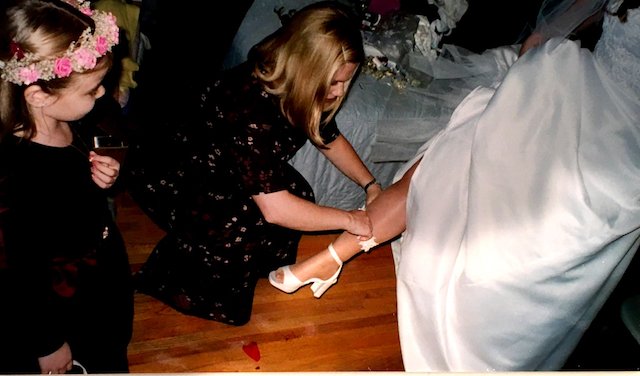
Dave and I at my sister, Brenda's wedding, October, 1999.
Dave and I at my sister, Brenda’s wedding, October, 1999. (I was 8 months pregnant.)

Note: I am not a psychiatrist, nor do I play one on tv. Keep in mind that my dad is a psychologist. Enjoy.

I am stealing that phrase from Dr. Gabor Maté. After posting about being “all in” yesterday, my friend nailed it and suggested I watch his Youtube Video titled, “When The Body Says No: Mind/Body Unity and the Stress-Disease Connection.”  Seeing as how I have the attention span of a fly, in bits and pieces I have been watching Dr Maté’s talk since then. The concept of the Please-Love-Me syndrome is sticking with me most.  The Please Love Me Syndrome is apparently an adaptive result of say some sort of stressor, like a rage-ful dad (his words). Consequently, because we want to please our (rageful) parent and because we crave their love, we learn to adapt, inevitably hiding our authentic selves. To a child this literally translate to the following coping mechanism:

“I will do whatever it takes for you to love me, or better, I will suppress who I am so you will love me and attach.”

My adult translation: “At all costs, I will take your shit.”

Pushing his please-love-me theory further, Dr. Maté suggests that when we repress our authentic self, we also stress our physical selves out, which he asserts leads to disease. Again my translation is the following: So to gain your asshole — that is to say, rage-ful — dad’s acceptance (love)  we learn to suppress who we are, and then we get sick. Eventually all that adaptive, stress-based self-suppression makes us sick. Weird I had a lot of stomach aches as a child. I have indigestion just thinking about my past. And now I have Celiac disease. Does correlation equal causation? Hmmmm. Obviously the correlation here is that we suppress ourselves because we fear making our mean dad mad (fear rejection). Eventually our adaptive please-love-me behavior becomes so reflexive that it transfers to our other relationships and literally becomes who we are. I am living proof.

Minneapolis, MN: My sister, Brenda's, wedding, October, 1999
Minneapolis, MN: My sister, Brenda’s, wedding, October, 1999

Consequently, as I search for meaning and search for Beth, Dr. Maté’s words resonate. The need to please has literally informed everything. For instance, I have a knack for being attracted to smart, creative,  funny, dynamic, super intense, unpredictable, and oh, very cruel, self-obsessed humans (all characteristics I would use to describe my dad). Often I am lucky and I find friends (and spouses) who share most of the traits (minus the douchebag ones).  At times I have wondered if my please-love-me behavior has morphed into some sort of crazy addiction. Meaning, I get a buzz off of your approval as much as your disapproval. In fact your disapproval only makes me try harder. Further, when I do attract a rageful beast, my please-love-me behavior becomes all-consuming, often spinning out of control. I never get it. Rageful beasts are never satisfied and simply feed off of rejecting all the please-love-me fools caught in their net.

Pushing the mean dad analogy further, I found it interesting that Dr. Maté used a rageful dad as an example. I kind of get it. Do we all have mean dads? No. In fact, Dave is the opposite of mean. He is kind, invested, esteem-promoting and knows his boys. Sadly, in contrast to Dave, my dad was anything but esteem-promoting. What I remember about my dad, which is not much, is that he always seemed disappointed, more specifically, disappointed in me. When it was my weekend to go to his house (yes, my parents were divorced), I never saw my dad. My brother had my dad’s attention, and I was pawned off to my stepmother, his second wife, and yes, they are divorced now too. When I was not with my stepmom, I spent my time far away in the basement where I was asked to remain.  Ergo, (because I have been dying to use this transitional word), in my dad’s basement, I slept, watched television and entertained myself. I always loved when my brother came downstairs. Eventually I stopped going to my dad’s. It would make sense (at least to me) that my brother would continue his weekend visits. He did. My brother also tells me that things were not much better for him. I do not disagree.

My awesome sister, Brenda, and I at her wedding, October, 1999, Minneapolis, MN.
My awesome sister, Brenda, and I at her wedding, October, 1999, Minneapolis, MN. (Yes. I am super duper pregnant in this photo. My sister is gorgeous!)

My relationship with my dad came down to the following conversation he had with my mom. I think it was a gift.  My dad firmly stated that he only wanted my three children, and that I was unwanted. Yes, I heard him say these words. Remember land lines?  Well, I was on one phone while my mom was on the other. My guess is my dad had no clue I was listening. I was. My mom had no idea he would say what he did. I know her heart dropped when she heard him say,

“I don’t want Beth.”

I know she wanted to grab the phone away from my ear. I was in another part of the house. Instead, I continued to quietly listen.

Here it is. I am the youngest child. I could never figure out my dad’s beef with me. In truth, I know his beef was with my mom. With her not present, I became the puppy he could kick. I always felt his rejection. I still feel his rejection. It is cruel and it is abrupt. The only way I could survive him (the beast) is if I let go and shut the door. I did. Ok. Sure, it took me several years to get the clue that my dad did not want me. Again I think it was a phone call. He called my therapist at the time a “shrink,” and since my dad was, ironically, in the mental health profession himself, his choice of that particular condescending term was deliberate. And as Eli most humorously conveys,


“Hey mom, condescending means ‘to talk down to.’”

My dad talked down to me and I was done. I did what I do to most beasts. I scream. I short-circuit. I swear and then I hang up, lock myself in my room, or go for a very long walk. And if we are really being truthful and I am, please know that  I will always, always hope for the beast’s  approval, LOVE, forgiveness, acceptance, and (for what I don’t know, but I still want it). For now, I have  learned to live without it.

My dad is now seventy-five. My last memory of seeing him in the flesh was nearly seventeen years ago and after the phone call when I hung up on him. He flew to Minnesota (so did I) for my sister Brenda’s wedding. I was approximately eight months pregnant with Kyle, and at the point where I should not be flying. I flew anyway.

After the ceremony, my dad walked over to me. He and I said very few words to each other, yet I felt joyous, as if we were long lost friends. As he spoke, he placed his hand on my large, pregnant belly. I stood there and his hand remained, firmly on my stomach. I was consumed with his hand placement and wondered,

“Will he like who I have turned out to be?”

In that moment, I adapted.

Duality is interesting. In a flash I also saw how his behavior as my parent had informed all of my decisions as an adult.  I knew I did not want to be him, but I really wanted him to like and accept me. I found his hand repellant, wanted it off of my belly and away from my unborn son, yet I felt elated while I basked in his approving touch. Because I did not feel comfortable asking him to take it off, his hand remained. Standing there I felt forced to think about us. I thought about him as a father. I was not him. I am not him. In those seconds it was clear. I knew I wanted to be different. I wanted to be a part of my child’s life. I also felt proud and peaceful. I take my marriage seriously. I did not marry because it was the next step in a religious expectation. Instead I married someone I liked, loved and felt really good about marrying (I love Dave). I resolved to have kids when I wanted to have them. I resolved to not blame my kids, but to take responsibility as the parent. I resolved to  be patient and remember that I am the teacher. I resolved to take responsibility and I resolved to apologize when I screw up. And when I had Kyle and Eli, I resolved never ever to reject them. I never will. Those boys are my heart and soul. Each day with them serves as a reminder of what my dad has missed – his choice, not mine.

He took his hand away and we have not spoken since.

Dave and baby Kyle, Salt Lake City, Utah early 2000.

Kyle and I at my friend, Melanie’s wedding, Atlanta, Georgia, May, 2000

As I wind this post down I keep thinking,

“If only all my problems, including my please-love-me affliction, were because of my bad relationship with my father. If only…”

Unfortunately life is not that simple. I get that. So for me being “all in” also means facing all of me.  Here is how I picture myself. I am mummy wrapped in layers (years-worth) of gauze. Now I think my life’s journey is about ripping off that gauze. Honestly, I am a little overwhelmed. I am wrapped in so much gauze that I look like a big, fluffy mummy.  I am certain (because I already have) that as I peel away that I will find scars, pain, scabs, blood and unhealed wounds. Most days I would much rather remain a fluffy, protected, gauze-y creature (fence-bound). I also know that my desperate please-love-me behavior wants to remain hidden. Yet when I muster the courage, I must admit that gauze removing rocks. It is always those times when I start to unwrap when I am reminded of the love and support and strength that envelops my world!

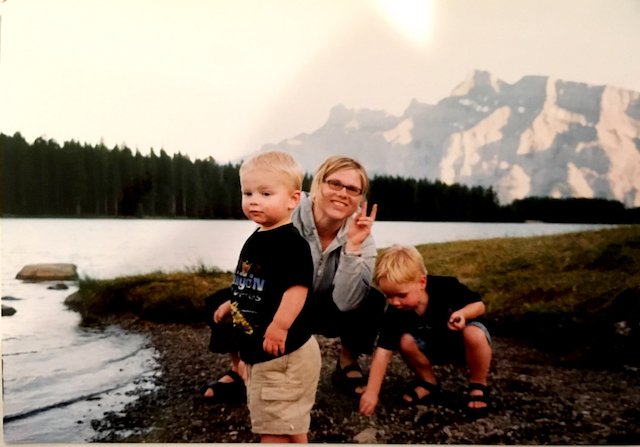
Eli and I, Banff National Park, Canada, July 2004

The boys and I, Banff National Park, Canada, July 2004

And all exposed I feel grateful. I am grateful I get to be Kyle and Eli’s mom. And I am grateful I have a partner who does not freak out if I tell you we had a fight. I am also grateful Dave supports my quest, or maybe he simply prefers human Beths to gauze-wrapped mummies.

Kyle and I at the Oregon Coast Summer 2003
Kyle and I at the Oregon Coast Summer 2004

PS. The best part of being a wife and a mom is that I get to be a part of Dave, Kyle and Eli’s amazing journey. I would not trade this gift for anything.